


 |
 |
|
Medicine in Ancient Egypt
| Egypt assignment index page | Intro | Pyramids | Calendar | Mathematics | Medicine |
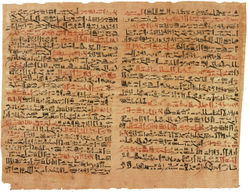 The
Edwin Smith surgical papyrus (left) is a ca. 1600 B.C.
copy of a surgical work from the third millenium containing an orderly presentation
of patient case histories, diagnoses, and prognoses. The text consists of 48
cases, each in a standard format including title, physical examination, diagnosis,
and surgical treatment. The manual is empirically based rather than theoretical.
Even 13 so-called "hopeless" cases are recorded, perhaps to spare
the physician legal expenses from costly liability suits!
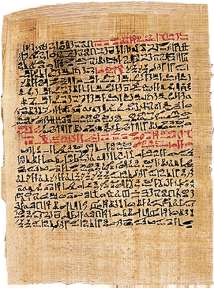 The
Ebers
medical papyrus (right), dates to ca. 1500 B.C. Compared with the
Edwin Smith papyrus, the Ebers papyrus has a greater emphasis on incantations
and spells. In one cure, the physician is to apply malachite to a cataract,
and then chant: "Come malachite. Come thou green one; come discharge from
Horus’ eye. Come secretion from Atum’s eye. Come fluid that has
come out of Osiris...” Treatment methods include prayer, sacrifices to
mollify the gods, and the recitation of spells to exorcise demons. Interestingly,
human skulls are found from this period with metal plates inserted to cover
wounds that successfully healed.
1. Read what Lindberg says about Egyptian medicine; Beginnings of Western Science:
2. Now study this overview of Egyptian medicine by Andre Dollinger, which includes
many excerpts of sayings from the Ebers and Edwin
Smith papyri:
http://www.reshafim.org.il/ad/egypt/timelines/topics/medicine.htm

The complete texts of these papyri are available online, linked to at the above websites, if you want to explore further!
| Egypt assignment index page | Intro | Pyramids | Calendar | Mathematics | Medicine |
Do you have a great quote for this page? Let me know! (If used, a new quote is worth 1 point extra credit)

|
HSCI 3013. History
of Science to 17th century |
spellcheck.net | wordcounter.net
Many thanks to the pedagogical model developed in Mythology and Folklore and other online courses by Laura Gibbs, which have been an inspiration for this course.
|
|
This course is currently undergoing major reconstruction to bring it into alignment with the new version of the course at Janux |
|||


