


 |
 |
|
Ancient Egypt: Introduction
| Egypt assignment index page | Intro | Pyramids | Calendar | Mathematics | Medicine |
I. 3000 BC: Unification and Early Dynastic Period
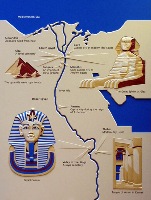 According
to the ancient Greek writer Herodotos, Egypt was "the gift of the Nile."
The Nile's annual floods deposited rich, black silt along its floodplain, which
gave rise to a land of fertile soil surrounded by desert on either side. Egyptian
civilization initially consisted of two regions:
Map from Norfolk Museums (click for larger view); see more maps at Ancient Egypt Online.
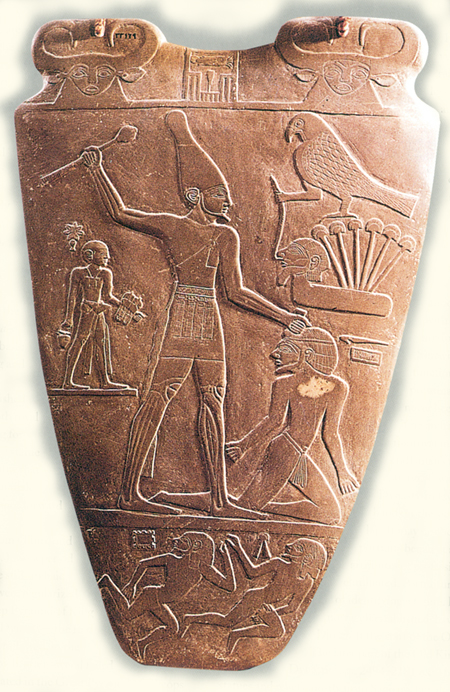 Narmer's
palette (ca. 3200 BC) is the oldest surviving image of a historic person
whose name is known (left; click any image on this page for a larger view).
Different scenes are arranged in horizontal bands on both front and back (the
front is shown). Artists of ancient Egypt strove to achieve a distinctive clarity
in their representations by several drawing
conventions, evident in this palette. Rather than depicting the human body
from a single perspective, they would select a different perspective for each
part in order to reveal that feature at its best. So, for example, the palette
displays an eye as seen from the front; a face as seen from the side in silhouette;
the torso from the front; legs from the side, etc. Yet unlike a modern Picasso,
not just any angle could be chosen: they only used perpendicular perspectives
displaying features in 90° relations. These perpendicular angles suffice
to portray the full face and shoulders, a strict profile of the head and legs,
or even to show features vertically from above. (More Narmer's palette; cf. Wikipedia.)
Around 3200 BC, Narmer, the ruler of Upper Egypt (whom Herodotos called Menes), conquered Lower Egypt and thus unified the entire land of the Nile, becoming the first pharoah. In the upper right of the Narmer palette a falcon represents Horus, the god of Upper Egypt. The falcon holds a head amidst papyrus flowers (common in the delta), symbolizing the conquest. Narmer's capital was at Memphis, and is not yet excavated. He established trade with Byblos in Phoenicia (modern Lebanon; Byblos later became a notable port through which papyrus scrolls were shipped to Europe). Signs of cultural contact and commercial exchange between Egyptian and Mesopotamian cultures at this time include knives, art, and the resemblance of early step pyramids to Mesopotamian ziggurats.
II. "Nothing surpasses books..."
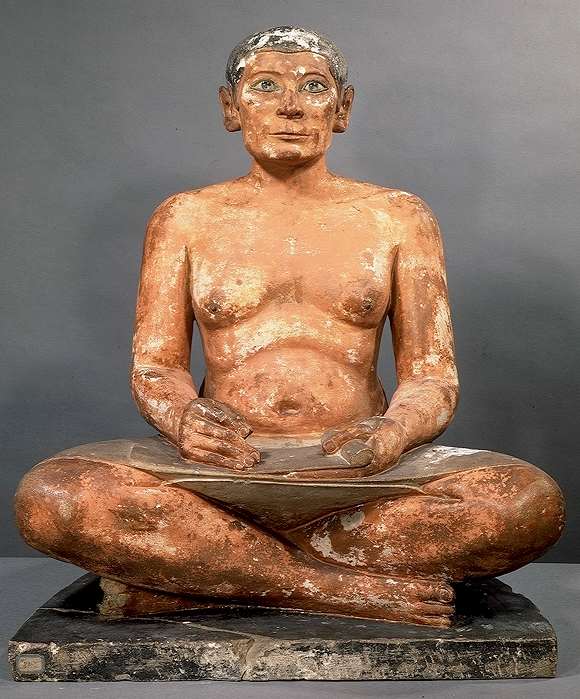 Egyptian writing, which exists from as early as 3100 BC, was in the form of
hieroglyphs. There was a hieroglyph, or symbol, for the sound of each syllable.
To record whatever a person says syllable-by-syllable requires about 300 symbols (a syllabary). Syllabaries contained too many symbols for most people to learn.
Thus in ancient Egypt, as in Mesopotamia, writing remained the secret art of
an elite group of scribes (left). One hieroglyphic papyrus dated to around 2150
B.C. records the counsel of an Egyptian priest to his son:
 "Behold,
nothing surpasses books. Would that I might make you love books more than your
mother. Would that I might make their beauty enter before your face, for it
is greater than any office. You are to set your heart on books."
The English word "book" derives from the Greek word "Biblion," which meant "from Byblos," referring to the papyri scrolls that were imported into Greece from Egypt via the Phoenician city. Ironically, no ancient papyri can be found in Byblos, since they deteriorate rapidly in all but the driest of climates. Only in the deserts of Egypt were papyri likely to survive. Humidity for objects buried in the hot sand is near zero -- this was fortunate not only for papyri, but also mummies themselves would likely have survived in the dry Egyptian climate even without mummification.
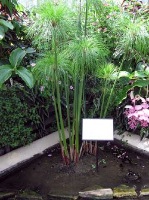
Assignment: Explore the University of Michigan page on how papyrus was made. Watch their Papyrus Making 101 Slide-show explaining how papyrus plants (right) were prepared as a medium for writing. The stalks of papyrus plants are 90% water. Once pithed, strips are glued into a cross-worked grid. Cuneiform tablets from Mesopotamia could be numbered and thereby hold a longer work, but it would be easy to lose separate tablets. With papyrus, the Egyptians could simply glue more strips to extend the cross-worked grid as long as necessary, then roll it up into a scroll.
 Try various places online where you can transcribe
your name into Egyptian hieroglyphics: University of Pennsylvania, guardians.net, discoveringegypt.com, or ehow.com (mine is
on the right). In Egyptian hieroglyphics, personal names were enclosed in a
rounded rectangle, as shown, called a cartouche. This feature of hieroglyphics
provided an essential clue to their decipherment in the 19th century by Champoleon
and Young, who first decoded the names of persons who were also known from other
sources.
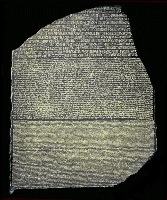 Europeans
had long puzzled over the meaning of hieroglyphics, which defeated the determined
attempts of linguists in the early modern period to figure out how to read them.
But in the early 19th century, Napoleon's invasion of Egypt provided an opportunity
for a breakthrough. In the words of the British Museum: "Soldiers in Napoleon's
army discovered the Rosetta Stone in 1799 while digging the foundations of an
addition to a fort near the town of el-Rashid (Rosetta). On Napoleon's defeat,
the stone became the property of the English under the terms of the Treaty of
Alexandria (1801) along with other antiquities that the French had found."
So the French who plundered the Egyptians were in turn plundered by the English;
that is why, to view many Egyptian artifacts today, you must go not to Africa
but to London, Paris or Berlin.
The Rosetta Stone is a fragment of black basalt measuring nearly 4 feet high by 2 1/2 feet wide. It is nearly a foot thick. When complete, it was probably 5 or 6 feet high, with carvings of people and gods that are now lost and broken off. The inscription is a civil decree from the Hellenistic period, ca. 200 BC. It is in two languages: Egyptian and Greek. However, the inscription is written in three different horizontal bands, each written with a different kind of script. As explained by the British Museum:
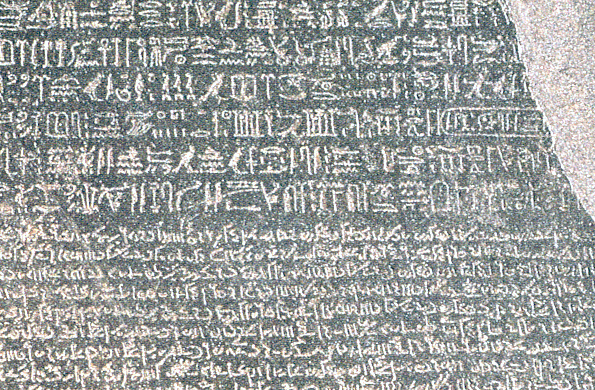
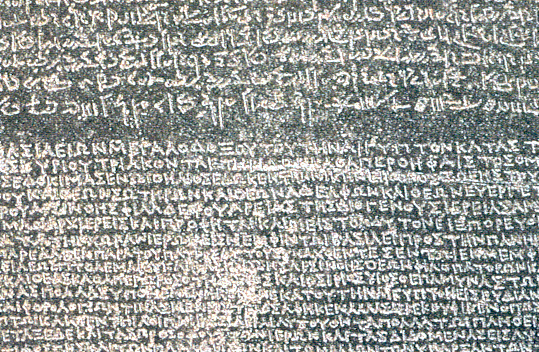 Close-ups:
hieroglyphic and demotic (left); demotic and Greek (right); click for larger
view.
"The decree is inscribed on the stone three times, in hieroglyphic (suitable for a priestly decree), demotic (the native script used for daily purposes), and Greek (the language of the administration). The importance of this to Egyptology is immense. Soon after the end of the fourth century AD, when hieroglyphs had gone out of use, the knowledge of how to read and write them disappeared. In the early years of the nineteenth century, some 1400 years later, scholars were able to use the Greek inscription on this stone as the key to decipher them. Thomas Young, an English physicist, was the first to show that some of the hieroglyphs on the Rosetta Stone wrote the sounds of a royal name, that of Ptolemy. The French scholar Jean-François Champollion then realized that hieroglyphs recorded the sound of the Egyptian language and laid the foundations of our knowledge of ancient Egyptian language and culture."
Listen to the Rosetta Stone episode of the British Museum's History of the World in 100 Objects (15 minutes).
III. Ten select aspects of ancient Egyptian culture
In what follows I have selected ten examples of artwork, sculpture, events, or important figures to give a brief impression of the character of ancient Egyptian culture. Think of them as my own personal "Top Ten" list, in roughly chronological order.
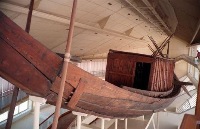 1. Model boats
Ancient Egyptian tombs frequently contain miniature models of household objects,
domesticated animals, and servants engaged in various activities. The spirits
represented by these models would accompany the dead person and serve him in
the afterlife. This practice affirmed a confidence that prosperity would continue
after death. The boat shown at the left is not a miniature model, however. Found
in the 1950's, this boat was one of two that served Khufu, the pharoah buried
in the Great pyramid of Giza. It is 142 feet long, built without nails, the
oldest intact ship, and apparently is seaworthy even today. (Solar boat museum.)
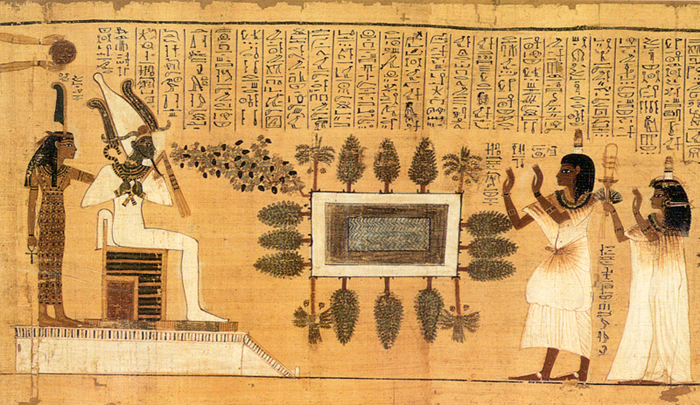 2.
Tomb paintings: Osiris (right)
Events of the afterlife were depicted in tomb paintings showing the functions
of the various Egyptian gods. The painting on the right shows Osiris,
a pharoah reputed to have originated the agricultural arts, who, after being
killed by his jackal-headed brother Set,
was resurrected into the eternal nighttime sky (ca.1200 B.C.). Other gods included
Ra (or Re), the
Sun god, who was sometimes conglomerated with local gods (e.g., Amon-Re); Nut,
goddess of the night sky; Thoth;
the god who invented writing; Isis,
the goddess of earth, fertility, and magic, who was also the sister and wife
of Osiris; and Horus,
the falcon-headed god of the sky who was the son of Osiris and Isis.
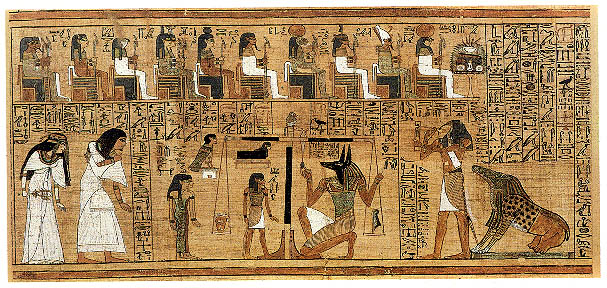 3.
Tomb paintings: Judgment of Ani (left)
This illustration from the Egyptian book of the dead papyrus shows
the weighing of the heart of a scribe named Ani. The heart, representing his
conscience, should weigh no more than a feather, which represents justice. Anubis,
the jackal-headed god of the underworld, is doing the weighing. Thoth,
the scribe of the gods standing to the right of Anubis, notes the result. (In
a later week, we will discuss the scientific influence of the hermetic movement,
which equated Thoth with Moses and the Greek god Hermes.) The twelve figures
at top of this painting are gods sitting as judges. At the lower left, Ani and
his wife wait in an attitude of devotion. (Click thumbnail for a complete view).
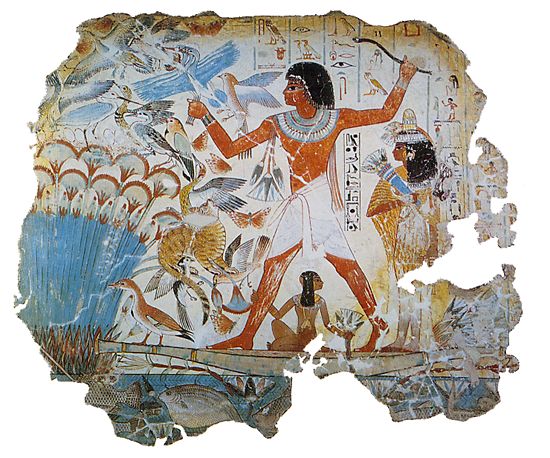 4.
Paintings: Natural Representations
From earliest times, ancient Egyptians displayed a capacity for keen
observation of nature, evidenced by beautiful artistic representations. Bronze
cats, alligators, and other natural phenomena are frequently depicted in the
art of ancient Egypt. Perhaps nowhere is this better illustrated than at Meidum,
an early pyramid site where six
geese are depicted of recognizable species, with individual feathering (ca.
2930 B.C.; click link below). Another of my favorite examples is "Fowling
in the marshes," from a tomb dated around 1400 B.C. (right, now in the British Museum). Click the
image to examine in a larger view the fowl rising above the papyrus plants.
Geese of Meidum; photo copyright ©2001-2002
by Lauren Ruth Wiener
(click image for larger view)

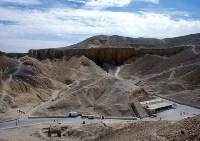 5.
Valley of the Kings. Middle Kingdom, 2040-1650 B.C. (right; image
source).
In the First Intermediate Period (2150–2040 B.C.), the pharoah's authority
collapsed and the higher priestly class rebelled. Eternal life became available
not just to the pharoahs on the basis of tombs, but to anyone on the basis of
an upright life. However, during the Middle Kingdom (2040-1650 B.C.), the pharoahs
revived their centralized authority and ruled from Thebes (modern Luxor). On
the west bank of the Nile across from Thebes they revived the practice of building
elaborate tombs in a site known as the Valley of the Kings. In contrast to the
earlier pyramids, burial sites in the Valley of the Kings were constructed with
elaborate concealment methods and deceptive tricks to thwart grave robbers.
Prisoners were hired for the construction of Thutmose’s tomb, then slaughtered
afterward to guard its secrets. However drastic the measures, they still did
not work. When Thutmose's tomb was rediscovered in 1899 it had been entirely
plundered except for the stone sarcophagus. The Valley of the Kings contains
62 known tombs.
6. Hyksos period and New Kingdom
 During the Second Intermediate Period (1650-1567 B.C.), Egypt was ruled by the
Hyksos.
The Hyksos were Semitic people with chariots and bronze weapons.
In the period of the New Kingdom (1567–1069 B.C.), the pharoahs ousted
the Hyksos and established imperialistic and commercial policies in Syria and
Palestine. During this time there was an influx of foreign ideas, styles, and
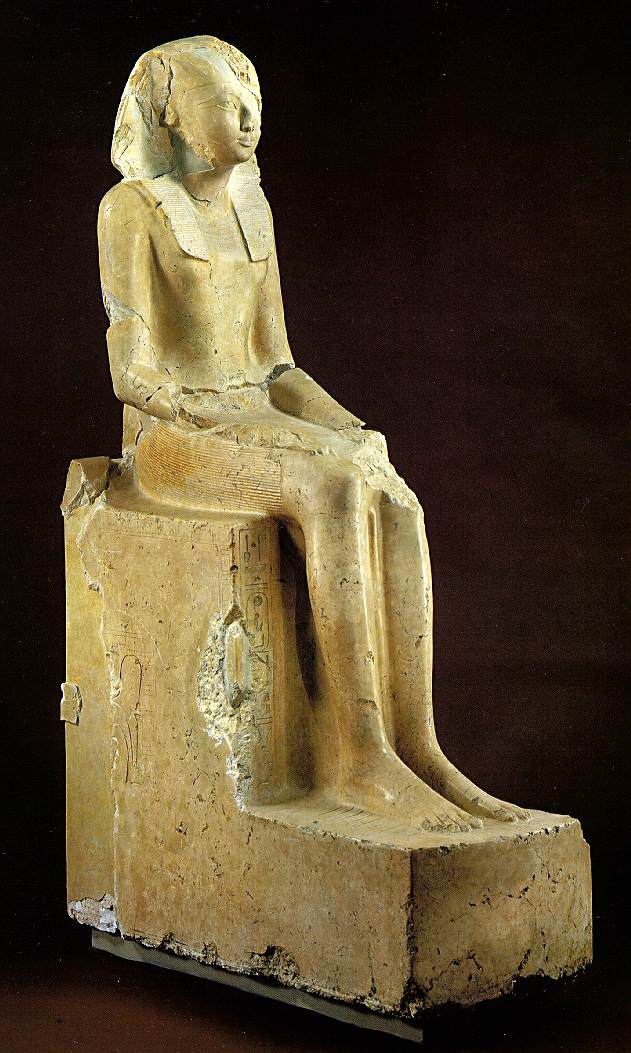
religions, and the priests of Amon-Re rivaled the pharoahs in power and wealth. Hatshepsut
(left; died ca. 1458 B.C.), sister and wife of Thuthmose II and mother of Thuthmose
III, was the first woman pharoah. When her husband died after ruling only a
few years, because Thuthmose III was still too young to rule, she reigned as
pharoah for 15 years. After her death, Thuthmose III systematically destroyed
her records and defaced her monuments, often simply changing the inscribed name
Hatshepsut to Thuthmose. As this story suggests, the chronology of Egypt is
full of controversy. Some scholars have speculated that Hatshepsut was the woman who rescued the
infant Moses from the rushes of the Nile, and that Moses' rivalry with Thutmose
III may have played a role in the antagonism of Thuthmose III toward Hatshepsut.
But all of this is speculation due to the fragmentary nature of the sources.
 7.
Akhenaten
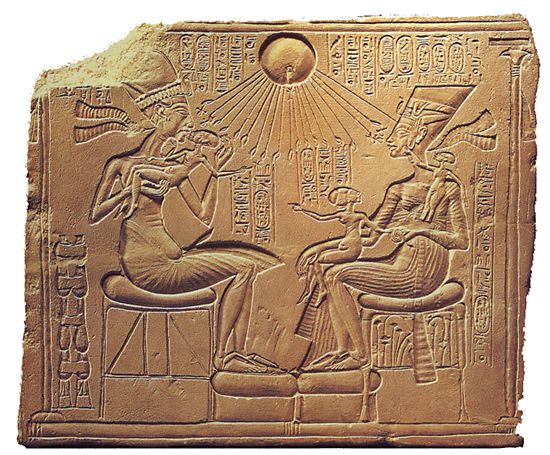
(right) reigned from 1367-1350 B.C. A few years into his reign, he changed his
name from Amenhotep IV to Akhenaten. He suppressed the cults of Amon-Re and
Osiris, and became a monotheist who worshipped the “Aten” (represented
by the
 Sun
in the picture to the right, and by rays of light whose ends are portrayed as
hands). A prayer to Aten survives: “O sole god, like whom there is no
other! You created the world according to your desire, while you were alone.”
However, monotheism in Egypt lasted no longer than Akhenaten, both due to the
power of the priests and to the cold and distant nature of the Aten, which could
only be worshipped by the pharoah’s family; everyone else worshipped the
pharoah.
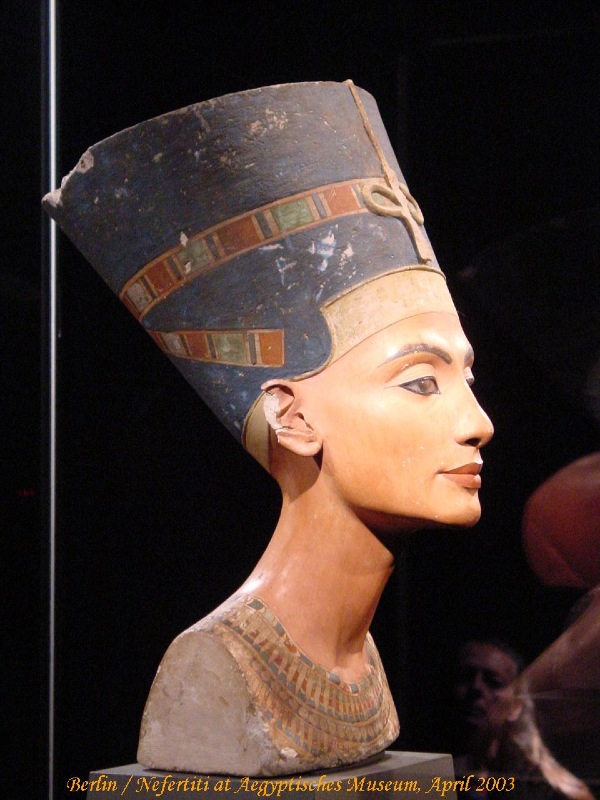
8. Nefertiti, ca. 1350 (left), was the wife of Akhenaten and mother-in-law of Tutankhamun. Both the depiction of the Aten (right) and the bust of Nefertiti (left) suggest that their reign saw a beautiful and distinctive new style of art, more fluid, not unlike art nouveaux.
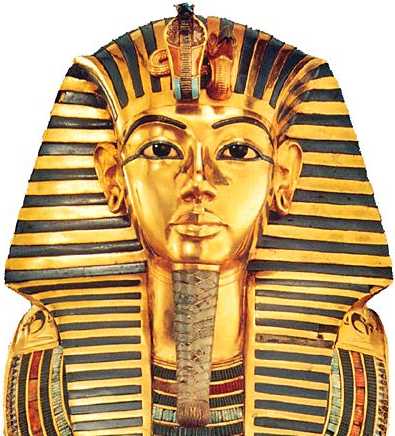 9.
Tutankhamun
(right), whose name means “Living image of the Amon,” was born Tutankhaten,
or “Living image of the Aten.” He reigned for nine years before
dying soon after Akhenaten at the age of 18. His unimportant tomb in the Valley
of the Kings was somehow overlooked by robbers, and discovered in 1922 by Howard
Carter. Its artifacts are now in the Cairo Museum. Steve Martin's song King
Tut appeared in 1978
 , the year after a sensational American tour of artifacts from Tut's tomb
called "Treasures
of Tutankhamun." (A video of Martin's song is widely available.) Many artifacts were on exhibit again in American museums during
2006-07.
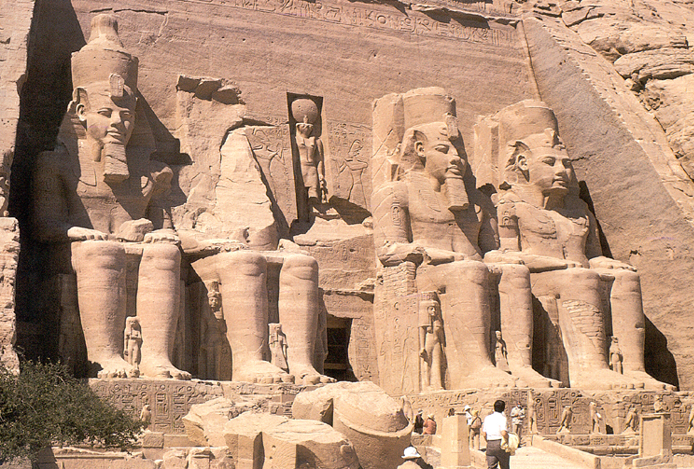 10.
Rameses II and the temple of Abu Simbel (left)
Rameses the
Great (reigned 1279-1213 B.C.) mounted the most ambitious building program
the world had ever seen. His grand buildings and monuments are found all over
Egypt today. For example, to impress Egypt's Nubian neighbors on the south border,
Rameses carved a spectacular temple into rock on a mountainside in Upper Egypt
near modern-day Aswan. When Lake Nasser was created by construction of the Aswan
dam in the 1960s, an international crisis was averted when the temple was dismantled
stone by stone and moved to a new location far above the lake's anticipated
water level where you can still visit it today.
 At
the mortuary temple known as the Ramesseum,
Rameses built a seven-story high statue that has since toppled over (shattered
head shown at right), prompting these famous lines from "Ozymandias,"
by Percy Bysshe Shelley ("Ozymandias" was the Greek name for Rameses
II):
Look on my Works ye Mighty, and despair!
Nothing beside remains. Round the decay
Of that colossal Wreck, boundless and bare
The lone and level sands stretch far away.
Rameses the Great, the most famous of the pharoahs, is often portrayed in popular
culture as the pharoah of the biblical exodus -- cf. Cecil
B. DeMille, The Exodus.
. Listen to the Rameses II Statue episode of the British Museum's History of the World in 100 Objects.

See the sources mentioned on the Egypt page, particularly C.W. Ceram. Gods, Graves and Scholars. Also at iTunes:
.
..
.
.Michael Gaddis, Syracuse University is the source for the following images on this page: Abu Simbel, Akhenaten, Fowling in the Marshes, garden couple, Hatshepsut, Narmer palette, Osiris and judgment tomb paintings, Rosetta Stone (and two close-ups), Saqqara, and the Seated scribe. Click on any of these images to see larger versions.
| Egypt assignment index page | Intro | Pyramids | Calendar | Mathematics | Medicine |
Do you have a great quote for this page? Let me know! (If used, a new quote is worth 1 point extra credit)

|
HSCI 3013. History
of Science to 17th century |
spellcheck.net | wordcounter.net
Many thanks to the pedagogical model developed in Mythology and Folklore and other online courses by Laura Gibbs, which have been an inspiration for this course.
|
|
This course is currently undergoing major reconstruction to bring it into alignment with the new version of the course at Janux |
|||


