


 |
 |
|
Boethius, On the Consolation of Philosophy (6th century B.C.)
| Source page | Hero | Cicero | Lucretius | Pliny the Elder | Ptolemy | Galen | Capella | Basil and Philoponos | Augustine | Boethius | Isidore of Seville | Benedict |
Source |
Boethius, On the Consolation of Philosophy, pp. 134-135. |
Translation |
W.V. Cooper. (London: Dent, 1902). |
Web
Source |
University of Virginia Electronic Text Center |
Word
count |
402 |
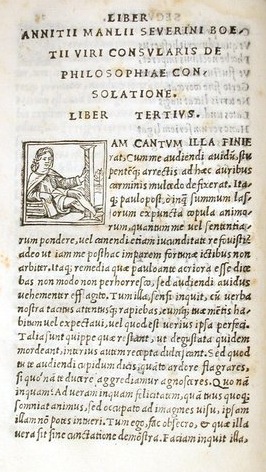 On the Consolation of Philosophy by Boethius (ca. 480 - 524 A.D.)
was perhaps the most widely copied non-religious work in medieval and early
modern Europe, translated by King Alfred, Chaucer, Queen Elizabeth I, among
many others. It is safe to say that it was read (and at least in part, memorized)
by nearly every educated European through the 18th century. Boethius wrote it
while imprisoned for apparent treason, perhaps knowing that his execution was
imminent.
The overall theme, the "consolation" of philosophy, is the insight that an order ("Providence") underlies even the greatest misfortunes (a tenet shared by Stoics and Christians). There is no opposition between the natural and the divine wisdom. In the excerpt below, Boethius suggested that because Providence orders nature according to constant laws; therefore one may have faith that the same Providence also orders human lives, even in the midst of suffering. The natural order thus underlies, for the philosopher, an ethical posture of acceptance of fortune, whether good or bad.
This fact illustrates how, throughout the time periods studied in this course, science held a central place in education precisely because it was not an isolated or specialized endeavor. Rather, natural philosophy was perceived as of great relevance to other areas of philosophy and human knowledge, particularly ethics (a link which began to break down in the 19th century with Alfred Lord Tennyson's depiction of nature as "red in tooth and claw").
pp. 134-135. 'If thou wouldst diligently behold with unsullied
mind the laws of the God of thunder upon high, look to the highest point of
heaven above. There, by a fair and equal compact, do the stars
keep their ancient peace. The sun is hurried on by its whirl of fire, but impedes
not the moon's cool orb. The Bear [Ursa
Major] turns its rushing course around the highest pole of the universe,
and dips not in the western depths, and though it sees the other constellations
sink, it never seeks to quench its flames in the ocean stream. In just
divisions of time does the evening star foretell the coming of the
late shadows, and, as Lucifer, brings back again the warming light of day. Thus
does the interchanging bond of love bring round their neverfailing courses;
and strife is for ever an exile from the starry realms. This
unity rules by fair limits the elements, so that wet yields
to dry, its opposite, and it faithfully joins cold to heat. Floating fire rises
up on high, and matter by its weight sinks down. From these same causes in warm
spring the flowering season breathes its scents; then the hot summer dries the
grain; then with its burden of fruits comes autumn again, and winter's falling
rain gives moisture. This mingling of seasons nourishes and brings forth all
on earth that has the breath of life; and again snatches them away and hides
them, whelming in death all that has arisen. Meanwhile the Creator sits on high,
rules all and guides, king and Lord, fount and source of all, Law itself and
wise judge of justice. He restrains all that stirs nature to motion, holds it
back, and makes firm all that would stray. If He were not to recall them to
their true paths, and set them again upon the circles of their courses, they
would be torn from their source and so would perish. This is the common bond
of love; all seek thus to be restrained by the limit of the good. In no other
manner can they endure if this bond of love be not turned round again, and if
the causes, which He has set, return not again.
'Do you see now,' she continued,' what follows
upon all that we have said? '
'What is it?' I asked.
'That all fortune is plainly good,'
she answered.
Consider these questions as you read in order to gauge your understanding of the text. Hint: You may want to print this page and mark the key words and phrases relevant to these questions.
Do you have a great quote for this page? Let me know! (If used, a new quote is worth 1 point extra credit)

|
HSCI 3013. History
of Science to 17th century |
spellcheck.net | wordcounter.net
Many thanks to the pedagogical model developed in Mythology and Folklore and other online courses by Laura Gibbs, which have been an inspiration for this course.
|
|
This course is currently undergoing major reconstruction to bring it into alignment with the new version of the course at Janux |
|||


