


 |
 |
|
What is nature? How is nature known?
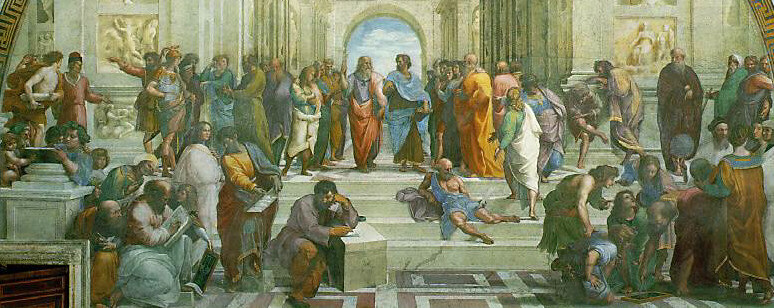
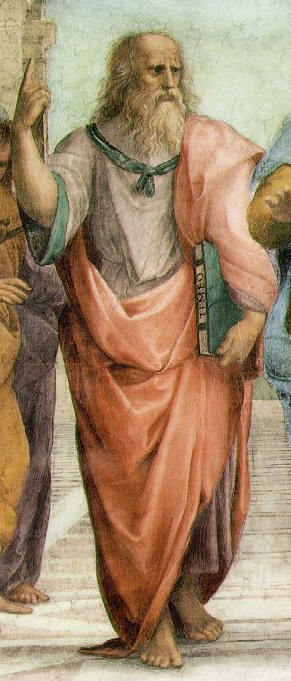
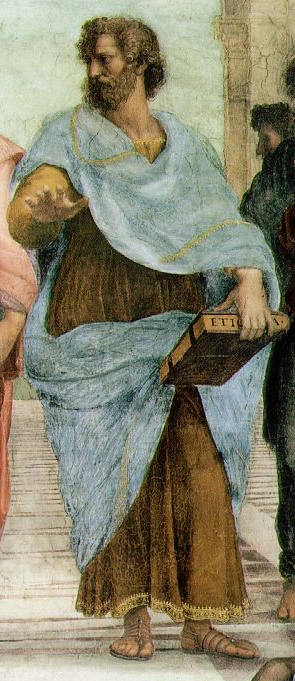
In Raphael's "The School of Athens," Plato and Aristotle each point to what they believed was real. With one finger pointing upward, Plato points to the realm of ideal forms. With fingers spread, pointing downward, Aristotle points to the physical world of particulars, where forms and matter are combined in individual things.
View Raphael's painting, The School of Athens, which adorns the ceiling of
St. Peter's basilica in the Vatican:
1. Scalable java applet at the Vatican website. Click on the two figures in the center to zoom in until you can see them in as much detail as you want.
2. Clickable version of the painting that identifies the figures Raphael included. You'll see many of the Presocratic philosophers from last week, too! Click on any figure to go to an explanation of that person.
3. Compare the Wikipedia version of the painting with identifications; and this higher resolution version of the full painting.
Put Plato and Aristotle in perspective:
| What is Nature? | How is Nature known? | ||
| Tradition | Type of explanation | Experience component | Mental component |
| Mesopotamian astronomy | Interpretation of natural phenomena as signs of the will of the gods; practical know-how; mathematical modeling | Long-term, organized, systematic observation | Mathematical description and quantitative prediction |
| Egyptian medicine | Interpretation of natural phenomena as signs of the will of the gods; practical know-how | empirical results
of medical regimens, surgical techniques |
Evaluation of case studies |
| Presocratic natural philosophy (physics) | Search for divine first principles understood as theoretical causes | Limited appeals to ordinary, individual experience | Logic |
| Pythagoreans | Numbers as the divine causes of nature | Numerical diagrams and occasional experiments | Geometrical proofs and contemplations of numbers |
| Plato | Forms as the divine causes of nature | Shadows, reflections, pointers | Mathematics, philosophy |
| Aristotle | Natural things contain within themselves the causes of their own motions (or changes). These causes are material, formal, efficient and final. | Extensive experience, observation, experiment | Logical syllogisms |

|
HSCI 3013. History
of Science to 17th century |
spellcheck.net | wordcounter.net
Many thanks to the pedagogical model developed in Mythology and Folklore and other online courses by Laura Gibbs, which have been an inspiration for this course.
|
|
This course is currently undergoing major reconstruction to bring it into alignment with the new version of the course at Janux |
|||


