


 |
 |
|
Zenon of Elea (fl. 450 B.C.)
| Presocratics Index | Intro
| Thales | Anaximandros
| Anaximenes | Herakleitos
| Parmenides | Zenon
| Melissos |
| Atomists: Leukippos and Demokritos |
Anaxagoras | Empedokles
| Significance of the Presocratics |
Zenon of Elea, a follower of Parmenides, continued to advance the logical case that contemporary accounts of change were incapable of giving a rational explanation, even on their own premises. In particular, Zenon proposed four paradoxes to demonstrate that motion is impossible:
1. The Dichotomy
It is impossible to cross any distance because one must first traverse half that distance. Before one can traverse half the distance, however, one must first cross half of that distance, and so on, to infinity. Because a line is infinitely divisible, there are an infinity of points that one must cross in order to go any distance. But it is impossible in a finite amount of time to cross an infinite number of points; therefore it is impossible to move any distance.
2. Achilles and the Tortoise
Achilles and the tortoise were about to race, when Achilles gave the tortoise a small head-start. But once the tortoise had a head-start, Achilles could never catch it, because before he can catch the tortoise he has to reach the point where the tortoise began. But by then the tortoise has moved on to another point, and Achilles must catch up to that point, and so on to infinity.
3. The Arrow
 What
if a line is not composed of continous distances, but of discrete intervals?
Might one evade the force of the previous paradoxes by denying the continuousness
of space, and the infinite divisibility of a line? If so, Zenon was ready with
another paradox designed to counter a premise of discrete, discontinuous space:
If motion occurs in discrete intervals, then at any given moment, an arrow flying
through space will be located at one of those discrete points. Since it will
be located at a single point, it cannot be moving at that moment. Moreover,
since its entire flight is comprised of the sum of these points, and since at
any of these points the arrow is not moving, therefore the arrow never moves.
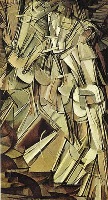
Marcel Duchamp, Nude
descending a staircase, 1912
Is it possible to go down the stairs one step at a time?
4. The Stadium
Suppose there are three chariots of the same size. One is stationary, one is passing to the right, and the other is passing to the left. At the same moment the two moving chariots pass the one that is stationary. If so, then each of the moving chariots would take only half as long to pass the other as to pass the stationary chariot. But how can half as long equal two?
The reductio ad absurdum strategy of Zeno's four paradoxes proved that motion (or change of any type) is impossible.
"Wait!"
Perhaps you want to shout to Parmenides and Zenon that you can see things move with your own eyes?
"I just saw Adrian Peterson running all the way down the football field!"
But your recollection of a football game is an argument from sensory experience, and it is clear that our senses deceive us. If we rely on our senses, we will follow the way of opinion, and then rational agreement will be impossible. The way of truth bids us to pursue the logic of the argument; only then will nature be truly known.
The legacy of the Eleatics was: if change is real, how can one logically defend it? In this sense, Zeno's paradoxes have delighted and bedeviled logicians ever since.
You can read Zenon fragments at the Hanover Historical Texts Project.
Physicist |
First
principle |
Character |
| Thales of Miletos | Water |
Monism |
| Anaximandros of Miletos | Apeiron |
Monism |
| Anaximenes of Miletos | Air |
Monism |
| Herakleitos of Ephesos | Fire |
Monism |
Parmenides of Elea, |
It |
Monism, Plenism, Rationalism, Necessitarianism, Sufficient Reason, Akinesis, Eternity of the World |
"In this capricious world nothing is more capricious than posthumous fame. One of the most notable victims of posterity's lack of judgement is the Eleatic Zeno. Having invented four arguments all immeasurably subtle and profound, the grossness of subsequent philosophers pronounced him to be a mere ingenious juggler, and his arguments to be one and all sophisms. After two thousand years of continual refutation, these sophisms were reinstated, and made the foundation of a mathematical renaissance..." Bertrand Russell, The Principles of Mathematics (1903)

|
HSCI 3013. History
of Science to 17th century |
spellcheck.net | wordcounter.net
Many thanks to the pedagogical model developed in Mythology and Folklore and other online courses by Laura Gibbs, which have been an inspiration for this course.
|
|
This course is currently undergoing major reconstruction to bring it into alignment with the new version of the course at Janux |
|||


