


 |
 |
|
3. Seek understanding before judgment
| Previous page | Stonehenge index | Next page |
"What did they think they were doing?" is the historian's first question -- NOT "Did they get this right?"
Voltaire said that history consists of the jokes we play on dead people. (I've posted a joke about Voltaire on my office door.) Many dead people would never recognize themselves by our descriptions of them. History should transport us back in time so that we see the world from the point of view of the historical figures themselves.
Forget modern astronomy; forget that the Earth goes around the Sun; forget all of the NASA photos of other planets or Earth from space. What did the people who built Stonehenge know?
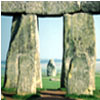
At Stonehenge (Britain), Woodhenge (Cahokia, Illinois), or other stone circles (e.g., Medicine Wheel, Wyoming), preliterate (but not pre-scientific) cultures charted seasonal time intervals by arranging sunrise markers sighted toward the eastern horizon.
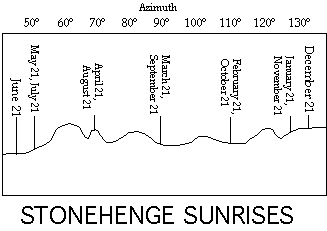
Points on the horizon are now identified by azimuth, where 0° = North, 90° = East, 180° = South, and 270° = west. If this is so, then examine the figure below, which shows points on the horizon. In which direction would you look to see the azimuths that are indicated? (Try it, then read on for the answer.)
In these terms, if you face east from within the circle of Stonehenge, then on different dates through the year you would see the Sun rise at points running north or south of due east as shown below. The position of the Sun changes its rising point along the horizon almost like a pendulum swinging back and forth. The two days each year when sunrises and sunsets reach their extreme northerly and southerly positions are called solstices. The two days each year when the Sun rises due east and sets due west are called equinoxes. (Explore the two links in this paragraph until you are certain you can imagine how these horizon phenomena appear. You do not need to pay attention now to the more detailed explanations of the motions of the Sun in Crowe.)
Similarly to the annual north-south journey of the Sun, the Moon also traces its rising and setting positions north and south along the horizon in a repeating pattern. However, the Moon's north-south motion is not nearly so regular as the Sun's, and recurs not annually but every 18.61 years. In the case of the Moon, the northerly and southerly extremes against the horizon (roughly 28.5 degrees from due east or west as seen from the equator; the range becomes greater as one moves away from the equator) are called "lunar standstills" (lunar standstills are analogous to the solstice locations for the Sun; cf. Crowe's diagram on p. 206).
The horizon points of solsticial sunrises and sunsets, or moonrises and moonsets at lunar standstills, are obvious astronomical phenomena that might have been observed by preliterate cultures using stone circles (or megaliths) like Stonehenge or Medicine Wheel. What do you think? Is it possible that preliterate cultures knew more about the motions of the Sun and Moon along the horizon than most 21st-century Americans do?
A quite plausible argument for significant alignments of the four Station Stones has been offered by Peter Newham, who has shown how the four Station Stones, along with the Heel Stone and three "postholes" about 800 feet distant, coincide with alignments for the following horizon events:
Crowe diagrams these positions on pp. 212 and 214. Take a look before reading further.
How should we interpret the existence of these alignments?
First we need to remember that scientific investigations were not made in a vacuum, but embedded in particular historical circumstances and cultures. Our task is to see how much more we can understand of the past with an historically-sympathetic view. We give up our privilege of living in a golden age; no such age is known in the historical past. The present isn't an ideal or perfect standard of comparison by any objective measure. And if the past is any guide, the future won't provide one either. Therefore let understanding take priority over judgment.
We must engage our imagination--by imagination I mean an unspecifiable human understanding, not a license to speculate--to make people of the past come alive from dry dust, so that even their most idiosyncratic or odd characteristics from our point of view seem believable after all. In contrast, a friend of Schopenhauer defined history as "the sum total of things that could have been avoided." Yet we will take a different path. Our first question is not: "What did they get right?" Our priority is not to judge what's correct and what's mistaken; e.g., how accurate were the astronomical alignments of Stonehenge? Or worse: Did they correctly understand the nature of the solar system? If you're a science major, this may disappoint you and be quite difficult for you. Please try to hold such questions until you can't stand it any longer, and then hold them back some more. Don't ask Did they get it right? until you know what they were trying to do on their own terms.
Ask rather: "What did they think they were doing? Can we understand how they expressed the meaning of the heavens in this stone artifact?"
| Previous page | Stonehenge index | Next page: Rational reconstruction is not history |
"What are the maxims of the new internal historiography? Insofar as possible
(it is never entirely so, nor could history be written if it were), the historian
should set aside the science that he knows. His science should be learned from
the textbooks and journals of the period he studies, and he should master these
and the indigenous traditions they display before grappling with innovators whose
discoveries or inventions changed the direction of scientific advance. Dealing
with innovators, the historian should try to think as they did. Recognizing that
scientists are often famous for results they did not intend, he should ask what
problems his subject worked at and how these became problems for him. Recognizing
that a historic discovery is rarely quite the one attributed to its author in
later textbooks (pedagogic goals inevitably transform a narrative), the historian
should ask what his subject thought he had discovered and what he took the basis
of that discovery to be. And in this process of reconstruction the historian should
pay particular attention to his subject's apparent errors, not for their own sake
but because they reveal far more of the mind at work than do the passages in which
a scientist seems to record a result or an argument that modern science still
retains."
--Thomas S. Kuhn, "The History of Science," in The Essential Tension:
Selected Studies in Scientific Tradition and Change (Chicago: University
of Chicago Press, 1977), p. 110.

|
HSCI 3013. History
of Science to 17th century |
spellcheck.net | wordcounter.net
Many thanks to the pedagogical model developed in Mythology and Folklore and other online courses by Laura Gibbs, which have been an inspiration for this course.
|
|
This course is currently undergoing major reconstruction to bring it into alignment with the new version of the course at Janux |
|||


