


 |
 |
|
2. The History of Science is a story...
| Previous page | Stonehenge index | Next page |
History is not a matter of memorizing dates because history is drama. Before specific episodes happened, people may not have known what to expect (any more than we can predict our future). In other words history is contingent, because things might have turned out differently than they did. (Something is "contingent" if it is not necessary and could have been otherwise.) Why did one thing happen rather than another? Why is it significant that it turned out the way it did?
Stories capture our imagination because of their drama, because of the uncertain
consequences of the choices and actions of creative people in interesting and
perhaps unfamiliar cultures, because of improbable successes, of startling transformations
and even revolutionary changes. History may seem dull if all we know is the
last page of the story, and if we forget the drama that led up to the present.
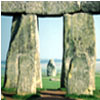
Apply this to Stonehenge by asking... what is the story of Stonehenge? And what
is the story of our understanding of Stonehenge?
How would you investigate both of these stories?
Look out: Neither I nor any human being can bring Stonehenge alive again, as a place imbued with meaning by the people who worshiped or celebrated or observed sunrises or moonsets there. History, including historians' accounts of Stonehenge, is fabricated by abstraction, creative mental reconstruction. Our stories are not reality as an omniscient mind would know it. To us the past is past and unchangeable, and this is why some people take it for granted and find it dull. But the study of the past can become exciting when we recognize that our knowledge of the past is incomplete and ever-changing.
To us the reality of the past is no longer directly accessible. We work only with its artifacts as they exist in our present. Consequently, to us, our mental knowledge of the past is necessarily fragmented, populated by dim shadows of reality as it was known to the people of the past. In other words, history requires explanations, or interpretations, in order to become meaningful.
What do we know of the real people who created Stonehenge? Not much. There are no inscriptions, no writings, no books in which they explained to us what they were doing and when they did it. Just a heap of stones. Throughout the medieval period covered by this course, most residents of Britain seemed satisfied with the explanation that giants had built Stonehenge, or perhaps Merlin constructed it by his strange magic arts. During the 16th and 17th centuries, the last centuries covered by this course, a variety of writers became interested in the study of Britain's past and offered novel theories to explain Stonehenge.
The writers mentioned by Crowe in his "Brief History of the Study of Stonehenge" did not agree on its original purpose (take time now to skim that section of Crowe's appendix, pp. 201-202).
How can we know its original purpose? Did the people who built Stonehenge express by it their understanding of natural phenomena? How? Is it astronomical? Why did they do it? How does it show us what they "knew"? This leads us to our third principle of historiography...
| Previous page | Stonehenge index | Next page: Seek understanding before judgment |
"Nor is thy Ston-Heng a less wonder grown,
Though once a Temple thought, now prov'd a Throne.
Since we, who are so bless'd with Monarchy,
Must gladly learn from thy Discovery,
That great Respects not only have been found
Where Gods were Worshipp'd, but where Kings were Crown'd."
--John Dryden (endorsing the views of Charleton)

|
HSCI 3013. History
of Science to 17th century |
spellcheck.net | wordcounter.net
Many thanks to the pedagogical model developed in Mythology and Folklore and other online courses by Laura Gibbs, which have been an inspiration for this course.
|
|
This course is currently undergoing major reconstruction to bring it into alignment with the new version of the course at Janux |
|||


