


 |
 |
|
The Black Plague
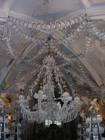 Kutna
Hora, located east of Prague in the Czech Republic, was a prosperous mining
town in the late middle ages and early modern period. During these centuries
it produced more silver, and minted more silver coins, than any other city in
Europe. When the plague struck Kutna Hora there was no room to bury the dead,
so bones were placed in a "charnal house" or ossuary. The ossuary
chandelier, shown at right, contains every bone found in the human body.
As we have seen, the early 14th century witnessed some very interesting developments in the history of science, particularly in the universities. However, a calamitous setback occurred with the onset of the Black Plague in 1348. By the end of the outbreak, 30 to 50% of the European population had died. Universities, city life, the arts, and the practice of science were all affected. In the face of the new epidemic, medieval medicine could offer no useful remedies; nor were novel alchemical preparations of any benefit. Two prerequisites for sustaining developments in science, the universities and a stable political environment, were severely undermined throughout Europe by the social consequences of the plague.
In the opening section of Decameron, the Italian writer Boccaccio recounted his observations of the plague. For this assignment, read all of the excerpts from Boccaccio compiled on the Eyewitness to History web page, and then read one brief account of the plague's cultural effects:
As you read these two web pages, ask yourself how the consequences of the plague might have affected the ability to sustain the development of medieval science. For comparison, consider how a pandemic of a new incurable disease or a continent-wide natural disaster, with a similar death rate as the 14th-century plague, would affect the practice of science in modern-day universities, institutions and corporations.
Source Quiz study questions
Dive Deeper
If you would like to know more about the Black Plague, try the following websites:

|
HSCI 3013. History
of Science to 17th century |
spellcheck.net | wordcounter.net
Many thanks to the pedagogical model developed in Mythology and Folklore and other online courses by Laura Gibbs, which have been an inspiration for this course.
|
|
This course is currently undergoing major reconstruction to bring it into alignment with the new version of the course at Janux |
|||


