


 |
 |
|
Theodoric of Freiberg: Optics of the Rainbow
Theodoric of Freiberg wrote a treatise on the rainbow, De iride, around 1310. This is about the same time as when Kamal al-Din similarly explained the colors of the rainbow. Because Theodoric worked far from the centers of Islamic science, he makes an interesting case study of the experimental methodologies in mathematical optics in Latin Europe in the 14th century.
Theodoric was a Dominican monk from Germany who studied in Paris for several years. Around 1304 the Master-General of the Dominican order suggested that he begin writing a treatise on the rainbow, which he completed in manuscript form around 1310. This comprehensive work built upon a long series of optical investigations of the rainbow stretching back to Aristotle, including medieval predecessors such as Ibn al-Haytham (Alhazen), Qutb al-din al-Shirazi, Robert Grosseteste, Roger Bacon, and Witelo. Theodoric's innovations derived also from his own extensive experimental investigations in which he used prisms, screens, and spherical flasks filled with water. Theodoric regarded a spherical flask as a model of a raindrop in a cloud. He observed that different colors appeared as he would raise the flask higher or lower. By covering certain portions of the flask at a time, one after another, to see where the light would come out, Theodoric determined the path that light follows from the Sun through the drop to the human eye to create a rainbow. Moreover, Theodoric also worked out the path light follows in creating the secondary rainbow. (From Aristotle's Meteorology it was known that the secondary rainbow may often be seen outside of the regular rainbow, fainter than the primary rainbow, and that rainbows always appear in the sky around a center that lies opposite the Sun.)
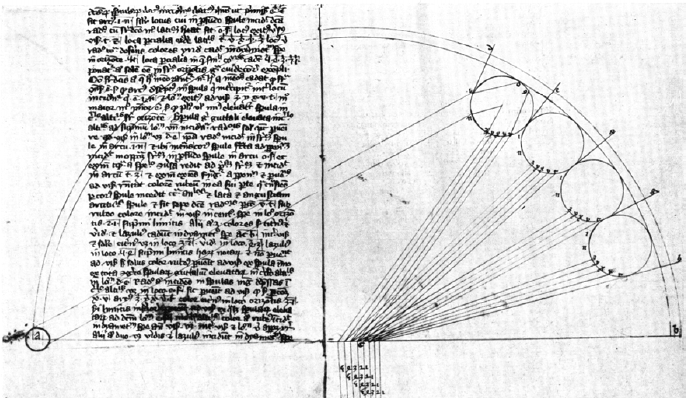 In
the diagram on the right from Theodoric's manuscript, the Sun
is located at the lower left corner. The eye of the observer
is in the center at the bottom, where the colors of the rainbow are signified
by different vertical bands or columns. The four circles on the right side represent
four flasks signifying raindrops in a cloud. For a secondary rainbow, each ray
of light from the Sun travels to the observer in four steps of refraction or
reflection:
The primary and secondary rainbows differ because the second reflection is omitted in the case of the primary rainbow, where light only has a single reflection in a three-step process. (Theodoric's diagram of the three-step process for the primary rainbow is not shown here.)
Note on terms:
Theodoric therefore concluded that, as a result of the three or four step process of refraction and reflection, one drop of water would send only one color of light to the eye of the observer. The rainbow results from a combination of many drops of water in a cloud at different positions from a center, where the drops at each distance from the center send a particular color of the rainbow.
While incomplete in several respects we need not explore here, Theodoric's explanation of the primary and secondary rainbows as a result of these three and four-step processes of refraction and reflection is still regarded as correct; that is, the paths traced by the rays of light through raindrops to produce both the primary and secondary rainbows was confirmed by Descartes in the 17th century. For this reason, Theodoric of Freiberg's discovery of the optics of the rainbow is often regarded as a triumph of experimental methodology in the late middle ages.
Dive Deeper
Source Quiz study questions
Do you have a great quote for this page? Let me know! (If used, a new quote is worth 1 point extra credit)

|
HSCI 3013. History
of Science to 17th century |
spellcheck.net | wordcounter.net
Many thanks to the pedagogical model developed in Mythology and Folklore and other online courses by Laura Gibbs, which have been an inspiration for this course.
|
|
This course is currently undergoing major reconstruction to bring it into alignment with the new version of the course at Janux |
|||


