|
 |
|
Nicole Oresme, Jean Buridan, and Theories of the Earth
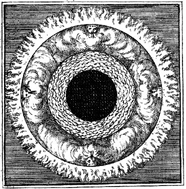 According
to Aristotle, each of the four elements beneath the Moon seek their natural
place. Fire and air obviously tend toward the upper regions; earth and water
tend to fall. If it were not for the processes of meteorology and geology that
continually mix the four elements together, one would expect the sublunar elements
eventually to settle out in four layers: earth - water -air -fire, from the
center out -- as shown in the diagram on the right. So the question arises:
Why does dry land exist above the level of the sea? And why
hasn't it all eroded down, so that water would cover all of the Earth?
Note: "Earth" is capitalized to refer to the planet or globe; "earth" is not capitalized to refer to one of the four elements which makes up the dry land.
In answer to these questions, there were at least four options (not mutually exclusive) open to medieval natural philosophers for explaining why land protrudes above the level of the sea. Most of these were expressed in the idiom of the biblical account of the creation week, where Genesis ch. 1 describes the original separation of the seas and the dry land as the chief event of the third day. Here are the four kinds of theories to explain the dry land:
 Rising
Land: In the thirteenth century it was sometimes supposed that if
God or nature once pushed back the waters to uncover any small portion of
the land (on the third day of creation or at any other time), then thus exposed
to the Sun, earth would thereafter continue to expand, forming subterraneous
caverns like air pockets in baking dough. In other words, the bulk of earth
would rise like bread where it is exposed to the Sun, whose
rays effectively cause it to bake. As a consequence, the dry earth floats
like a cork upon the water, emerging above the sea in the known world
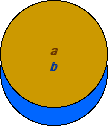
(brown circle, right) and producing a watery hemisphere on
the far side (blue circle, right). Although not unchallenged, belief in a
watery hemisphere was prevelant in ancient and medieval geography. Indeed,
apart from this belief it is impossible to understand why so many scholars
suspected that Columbus and his crew would succumb to malnutrition and starvation
before completing their journey to Asia across the vast Atlantic.
Options #1 and #2 presume a relatively young Earth subject to destruction by erosion, and exemplify directionalist sensibilities of an Earth in decay. Options #3 and #4, which allow a perpetual habitation upon dry land, were more consistent with cyclic or steady-state views and did not require a young Earth. All four options were consistent with the existence of caverns and subterraneous cavities, and all four views were widely discussed and held. They were not mutually exclusive.
In
the fourteenth century an Archimedean twist was added to the last option, that
of the rising land. The works of Archimedes
were translated by William Moerbeke in 1269, and in the late middle ages they
prompted sustained investigation into problems involving centers of
gravity. A number of medieval natural philosophers, including Jean
Buridan and Nicole Oresme, postulated that the Earth’s center
of gravity does not coincide with the center of the Earth’s
magnitude (or volume), resulting in a sphere of water
around the center of gravity, "b" (blue circle, right)
that is distinct from the sphere of dry earth around the center
of magnitude, "a"(brown circle, right).
Jean Buridan summarized his view as follows: “And there is a conception that in the uncovered part the earth is altered by air and the sun’s heat, and much air is mixed with it, so that this earth becomes rarer and lighter and has many pores filled with air or subtle bodies. However, the part of the earth covered with waters is not altered by air and sun and therefore remains denser and heavier. And therefore, if the earth were divided through the middle [center] of its magnitude [volume], one part would be much heavier than another, but that part which is uncovered would be much lighter. It seems, then, that there is one center of magnitude [volume] of the earth and another center of gravity.... its center of gravity is in the middle of the universe and not its center of magnitude. It is because of this that the earth is raised above the water on one side and is wholly under water on the other side.” Edward Grant, trans. and ed., A Source Book in Medieval Science (Cambridge: Harvard University Press, 1974), 623.
Such Archimedean theories of the Earth emphasized the renewability of the dry land and allowed for a perpetually-habitable globe. Neither Buridan nor Oresme believed there had actually been an initial watery state or literal days of the creation week; these were logical constructs used to clarify ideas. And the biblical text was often interpreted in a non-temporal sense even by theologians (as we have seen in the case of Augustine). Buridan and Oresme regarded the Earth’s duration as potentially eternal for the sake of philosophical investigation.
In the following table, quotations from Buridan and Oresme will illustrate several specific aspects of 14th-century Archimedean Theories of the Earth.
| Main Point / Description |
Quotation / Diagram |
| Initial conditions: Described in terms of the Archimedean concept of centers of gravity and magnitude. The Neptunist state, when water covered the earth, is shown here. (This state existed before the third day in commentaries on the creation week; it was a nonexistent mental abstraction according to Aristotelian meteorological theories.) |
|
| Question of Purpose: The initial conditions are contrary to the purpose of the globe, which is habitability. How, then, is that end maintained throughout all time despite erosion? |
“God and nature have ordained that the earth should be thus exposed so that men and animals can live there;... the rest or remainder is enveloped by water and clothed or covered by the sea as with a hood or cap: The deep, like a garment, is its clothing.” (Oresme, 569) |
| Two hemispheres: The solid earth (brown circle, top) and watery hemisphere (blue circle, bottom) do not coincide because the solid earth is heterogenous (containing cavities, metals, rocks of differing hardness, etc.) rather than of uniform composition. As a consequence it is possible to distinguish two different centers: a = center of the magnitude (quantité) or volume of the earth. b = center of the universe (monde), center of the earth’s weight (pesanteur), center of the sea. |
|
Mechanism for Maintaining Habitable Dry Land: 1. Debris eroded from the continents (which makes the sea salty) becomes... 2. deposited and coagulated into stratified, fossiliferous layers on the bottom of the ocean (brown and white spotted layer, right). |
Erosion and Marine deposition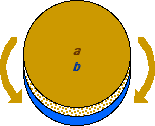 “By this another doubt is solved, evidently, whether the earth is
sometimes moved according to its whole in a straight line. We can answer
in the affirmative because from this higher part of the earth many parts
of the earth (i.e., debris) continually flow along with the rivers to the
bottom of the sea, and thus the earth is augmented in the covered part and
is diminished in the uncovered part.” (Buridan, in Clagett, 597-598) |
3. Elevation: As various Archimedean theorists noted, variations on this process have the potential to explain earthquakes, the generation and destruction of mountains, and given an indefinite passing of time, the presence of marine fossils in strata on the tops of mountains. |
Elevation due to Shifting of Center of Gravity “The generation of the highest mountains is thus also saved, because there are very dissimilar parts within the earth -- as diggings show....” (Buridan, Grant, 623) |
| Mechanism for the Deluge: In addition to the phenomena noted above, this theory provides a mechanism to explain the Deluge of Noah. To return the Earth to the watery state nothing more is required than to make the centers of gravity and magnitude once again coincide, like bobbing a cork underneath the water (cf. initial conditions, first row above). |
“From what has been said, it can be inferred that, if God and nature caused the habitable portion of the earth to become as heavy as the other or caused the weight of the other part to diminish so that the whole earth were uniform in weight in all its parts, then the habitable portion would be lowered and the whole earth would be plunged into the sea and covered with water, just as a man covers his face with his hood. Thus, there could be a universal deluge without rain.” (Oresme, 569–570) |
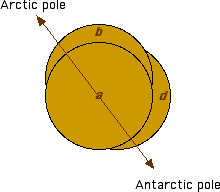
Mechanism for Displacement of land and sea; Polar wandering:
This theory did not require that the dry land and watery hemisphere always remain in the same orientation. Consistent with a theory of the Earth “according to Aristotle” the relative boundaries of land and sea may be displaced after thousands of years. Oresme supposed that elemental transformations between earth and water might shift the relative bulk of the earth and cause the surface of the earth to change position with respect to the poles. He noted that polar wandering would cause the sun and stars as seen from point b to rise in the west and set in the east (rather than rise in the east and set in the west, as they do today). Oresme cited traditions which alleged that such a change had actually happened more than once during Egyptian civilization. (Oresme, 573, 97.) |
“Therefore, assuming some notable addition to be made by generation in some part of our earth, such as, for example, the part in which we live... which part is indicated as b... I say that... according to Aristotle... the place b where we are would descend toward the center of the universe called a, as can be imagined from the diagram. Next, I imagine that a similar addition was made to the earth towards the south at the place marked d, which is distant from b by one-quarter of the earth’s circumference; I say that in this way d would be drawn toward the center of the universe and that, consequently, b would be drawn farther toward the left. It is clear that, as a result, that b, where we are, would move toward the arctic pole.... Let us assume, as is possible, that this elevation of the pole amounted to one degree and that much later, in the same manner, the pole were raised another degree, and then another, and another, and so on; I say that this process could go on naturally for thousands and thousands of years until b, where we are, would have traveled half-way around the circumference and would be positioned with respect to the antarctic pole just as we are to the arctic pole and that the antarctic pole would be above b the same number of degrees that the arctic pole now is. This being so... I say that the sun and stars at b would rise from the part we call west and would set in the opposite direction.” (Oresme, 571) |
Source Quiz study questions
Jean Buridan, Questiones super tres primos libros metheororum et super majorem partem quarti a magistro Jo. Buridam. Queritur consequenter 20° de permutatione marium ad aridam et econverso (Bibliothèque Nationale, fonds Latin, ms no. 14.723), cited by Duhem who provides French translations of excerpts. Translated excerpts from Buridan are provided in Marshall Clagett, The Science of Mechanics in the Middle Ages (Madison: University of Wisconsin Press, 1959), 594–599; and Edward Grant, trans. and ed., A Source Book in Medieval Science (Cambridge: Harvard University Press, 1974), 621–624.
Nicole Oresme, Le Livre du Ciel et du Monde, trans. Albert D. Menut, ed. Albert D. Menut and Alexander J. Denomy (Madison: University of Wisconsin Press, 1968). On this web page Oresme quotations are from Le Livre du Ciel et du Monde, and Buridan quotations are from Clagett or Grant, Sourcebook; in all quotations slight emendations have been made, particularly the substitution of “universe” for “world” in the translation of “monde” and “mundus.”
The most comprehensive discussions of Archimedean theories of the Earth are Pierre Duhem, Cinquième Partie: La Physique Parisienne au XIVe Siècle (suite), vol. 9 of Le Système du Monde: Histoire des Doctrines Cosmologiques de Platon a Copernic (Paris: Hermann, 1958), especially 293-308; and Edward Grant, “In Defense of the Earth’s Centrality and Immobility: Scholastic Reaction to Copernicanism in the Seventeenth Century,” Transactions of the American Philosophical Society 74 (1984): 1-69. The latter is summarized in Edward Grant, Planets, Stars, and Orbs: The Medieval Cosmos, 1200-1687 (Cambridge: Cambridge University Press, 1994), chapter 20. Duhem characterizes Oresme as a critic of Buridan, but for the present purpose of exemplifying general features of Archimedean theories of the Earth their views may be treated in a composite manner, as in the table above, without concern for their differences. See also Ernest A. Moody, “John Buridan on the Habitability of the Earth,” Speculum 16 (1941): 415-425, reprinted in Studies in Medieval Philosophy, Science, and Logic: Collected Papers 1933-1969 (Berkeley: University of California Press, 1975), 111-125.
Do you have a great quote for this page? Let me know! (If used, a new quote is worth 1 point extra credit)

|
HSCI 3013. History
of Science to 17th century |
spellcheck.net | wordcounter.net
Many thanks to the pedagogical model developed in Mythology and Folklore and other online courses by Laura Gibbs, which have been an inspiration for this course.
|
|
This course is currently undergoing major reconstruction to bring it into alignment with the new version of the course at Janux |
|||

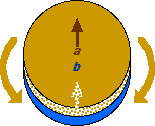 “Consequently,
the center of gravity does not remain the same as it was before. Now,
therefore, with the center of gravity changed, that which has newly become
the center of gravity is moved so that it will coincide with the center
of the universe, and that point which was the center of gravity before
ascends and recedes, and thus the whole earth is elevated toward the uncovered
part so that the center of gravity might always become the center of the
universe.” (Buridan, in Clagett, 597-598)