


 |
 |
|
Apollonios of Perge, fl. 220 BC
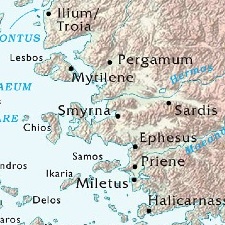
 Apollonios
of Perge (third century B.C., in southern Asia Minor), travelled to Alexandria
during the reigns of the third and fourth Ptolemies (247-222 and 222-205, respectively),
and worked in Pergamos during the reign of Eudemos and of his
successor, Attalos (241-197).
In the Konika (Conics), Apollonios examined the properties of conic sections; namely, the:
Later, in the sixteenth and seventeenth centuries A.D., Galileo would use Apollonios' work in his study of projectile motion, and Kepler would draw upon it in his determinations of planetary orbits.
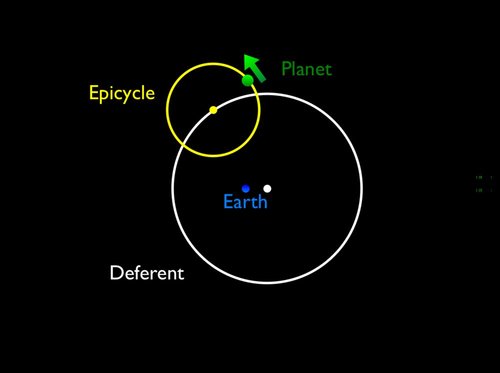
Ptolemy, the great second century A.D. astronomer who worked in Alexandria (of no relation to the Hellenistic ruling dynasty), credited Apollonios with the development of epicycle systems and eccentric circles, which were almost immediately applied to astronomical theory, particularly by Hipparchos of Nikaia (second century B.C.). The deferent-epicycle system, as well as the eccentric, account for differences in the lengths of the seasons as well as for changes in the apparent magnitudes of planets observed during their retrograde motions, and both endured as valuable astronomical techniques as late as the work of Copernicus in the sixteenth century A.D.
Do you have a great quote for this page? Let me know! (If used, a new quote is worth 1 point extra credit)

|
HSCI 3013. History
of Science to 17th century |
spellcheck.net | wordcounter.net
Many thanks to the pedagogical model developed in Mythology and Folklore and other online courses by Laura Gibbs, which have been an inspiration for this course.
|
|
This course is currently undergoing major reconstruction to bring it into alignment with the new version of the course at Janux |
|||


