


 |
 |
|
Pythagoras of Samos (fl. 525 BC)
| Return to Primary Sources assignment page | Next |
Background
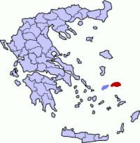
 Pythagoras migrated from his birthplace, the island of Samos
(map. left), to Kroton, a Greek colony right on the boot-heel of Italy (map,
right; click for a larger view of Magna Graecia at Wikipedia).
In Kroton he established a co-educational religious community. Members were charged with secrecy and many of their practices remain shrouded in mystery. However, Pythagoreans followed various purifying practices, including dietary restrictions such as "the Pythagorean maxim," or "Never eat beans," alluded to humorously in the American novel Moby Dick (see the bottom of this page). Beans may have been taboo because of a perceived resemblance to the human kidney, linked with a belief in the transmigration of the soul (reincarnation). For example, Xenophanes of Kolophon reported that Pythagoras criticized a man who was beating a dog, saying: "Stop, do not hurt him. It is the soul of a friend. I recognize his voice."
Yet the Pythagorean community is best known for another kind of religious obligation: the tending of the harmonies of the soul through the contemplation of mathematics: "The search for knowledge is the greatest purification." As we saw last week, for the ancient Near East mathematics served as a calculating aid for ordering the affairs of an authoritarian state (in commerce, construction, and above all, astrology or mathematical astronomy). In contrast, as an autonomous community, the Pythagoreans divorced mathematics from centralized state control. In the setting of their mystical community, they transformed it into the chief handmaiden of philosophy, bolstered as before in a religious context. As in the Ancient Near East, mathematics remained the secret knowledge of a religious elite. But instead of serving as the chief instrument for determining the will of the gods, for the Pythagoreans numbers themselves became the new divinities, on which all natural phenomena depend.
Ten
The number ten was considered a perfect number, partly because it was the sum of an interesting series of the first four integers:
1 + 2 + 3 + 4 = 10
The Pythagoreans held to the divinity (or self-existence) of Number. To them, numerical entities were eternal and immutable. All objects in the universe depended, in their view, upon Number and the relations between numbers. A Pythagorean prayer to the number ten has been preserved:
“Bless us, divine number, thou who generatest gods and men! O holy, holy tetraktys, thou that containest the root and source of eternally-flowing creation!”
Before we all laugh because of the unexpected presence of religion in mathematics, consider Stephen Hawking, who in A Brief History of Time described his search for a mathematical equation for the universe so compelling that, of itself, it could call the universe into existence. Hawking was then not far from a Pythagorean-like perspective, nor are many modern theoretical physicists.
A Pythagorean vocabulary:
theoria (contemplation)
kosmos (a universe of order)
katharsis (purification)
schole ("leisure" --> "school")
mania ("orgy") --> "enthusiasm" (en-theos) --> sophos
philosophia ()
mathematikos (fond of learning)
bios theoretikos (the theoretical life)
The concerns of physics -- i.e., matter, and changes in matter -- could be turned in another direction. Although Aristotle did not call them physicists, the Pythagoreans advocated a “substance” underlying the natural appearances, though not a material substance. The primary claim of the Pythagoreans was that “all things are number.” Contemplation of number and the relations of numbers, for them, held the key to the understanding of nature and its changes. With the Milesians, Herakleitos, and other Presocratics, natural philosophy or physics dealt with matter in motion; how to explain matter and changes in matter. The Pythagoreans rejected the materialist and monistic views of nature held by the Milesians, and instead drew attention to the elements of numbers, by emphasizing various dualisms within numbers (e.g., Great-Small).
Macrocosm-Microcosm correspondences
Music a branch of mathematics
Harmonious ratios (music a branch of mathematics). Simple whole-number ratios, such as 2:1 and 3:2, must be harmonious.
Neglect tension in string.
Examine this explanation of Pythagoras' application of the study of numbers to music:
http://www.aboutscotland.com/harmony/prop.html
Click the hands to hear the sounds.
Aristotle: "Since of these principles numbers are by nature the first, and in numbers they seemed to see many resemblances to the things that exist and come into being -- more than in fire and earth and water (such and such a modification of numbers being justice, another being soul and reason, another being opportunity -- and similarly almost all other things being numerically expressible); since again they saw that the attributes and the ratios of the musical scales were expressible in numbers; since, then, all other things seemed in their whole nature to be modelled after numbers, and numbers seemed to be the first things in the whole of nature, they supposed the elements of numbers to be the elements of all things, and the whole heaven to be a musical scale and a number. And all the properties of numbers and scales which they could show to agree with the attributes and parts and the whole arrangment of the heavens, they collected and fitted into their scheme; and if there was a gap anywhere, they readily made additions so as to make their whole theory coherent. E.g. as the number 10 is thought to be perfect and to comprise the whole nature of numbers, they say that the bodies which move through the heavens are ten, but as the visible bodies are only nine, to meet this they invent a tenth the 'counter-earth.'" (Aristotle, Metaphysics A5, 985b23ff.)
Aristotle wondered, however: "Number is not a thing, it is an attribute of things. I understand what is meant by a number of things, but not by a thing of numbers."
Music was one of the four mathematical sciences included in the "Seven Liberal Arts" of a classical education. The others were geometry, arithmetic, and astronomy. Music and astronomy were considered "sister sciences," because music was a branch of arithmetic and astronomy was a branch of geometry (see table below).
Trivium |
Quadrivium |
|||
Logic |
Grammar |
Rhetoric |
Arithmetic |
Geometry |
Music |
Astronomy |
|||
Pythagorean Theorem
a2 + b2 = c2
As we saw in Stars over Babylon last week, the Babylonians could generate numbers at will to satisfy the Pythagorean relationship (as shown in the Plimpton 322 tablet of Columbia University). Yet using a known relation as a calculating device was not the aim of the Pythagoreans, for whom the construction and contemplation of a geometrical proof might fulfil the religious obligation of tuning the harmony of one's soul. So the Pythagorean theorem, although known to the Babylonians, was now generalized and demonstrated as a necessary truth, not just a result of a calculation.
Work your way step by step through this interactive proof of the Pythagorean Theorem (requires java): http://www.sunsite.ubc.ca/LivingMathematics/V001N01/UBCExamples/Pythagoras/pythagoras.html
Numbers and Geometry
Square Root of 2
As we saw in Stars over Babylon last week, the Babylonians calculated the value of the square root of 2. Yale University tablet YBC 7289 shows an Old Babylonian value that, when converted to decimal notation, is correct to 6 significant figures, with an error of only one in the seventh place.
Proved the irrationality of the square root of 2. Not a proportion of two integers. Incommensurability of the diagonal with the side of a square. Can't measure this empirically!
Regular solids
Polyhedron |
#
of faces |
face |
image |
Tetrahedron |
4 |
equilateral
triangle |
|
Cube |
6 |
square |
|
Octahedron |
8 |
equilateral
triangle |
|
Dodecahedron |
12 |
equilateral
pentagon |
|
Icosohedron |
20 |
equilateral
triangle |
Philolaos of Kroton and Pythagorean cosmology
Surely this harmonious universe must have a beautiful shape; therefore it must be a sphere, lined with stars. An orderly kosmos.
The Earth, then, must also be spherical. Then why does it not appear spherical? Surely, the Earth must be too large to observe its curvature. Not an observation but an intellectual idea. Use theory -- geometry -- to correct common sense experience and to explain why ordinary observations are mistaken.
If you believe the Earth is spherical, how do you know? Authority?
There have been no educated flat-earthers from the Pythagoreans on.
Philolaos: "You can see the power of number exercising itself not only in the affairs of demons and of gods, but in all the acts and thoughts of men, in all handicrafts, and in music."
Ten was considered a perfect number, partly because it was the sum of the interesting series 1 + 2 + 3 + 4.
Yet there were only nine bodies: the Earth, Moon, Sun, Venus, Mercury, Mars,
Jupiter, Saturn, and the sphere of fixed stars. How could this be in a universe
that was composed of beautiful harmonies (i.e., there must be a 10th body in
the universe)?
The solution was to put the Earth in motion, along with a Counter-Earth, about
a central fire, thus yielding ten bodies and a perfect cosmos.
Study Questions:
Additional Pythagoras fragments (from Hanover Historical Texts Project)
Passages in Plato referring to the Pythagoreans
Plato, Gorg. 507 A. And the wise men say that one community embraces heaven and earth and gods and men and friendship and order and temperance and righteousness, and for that reason they call this whole a universe, [Page 134] my friend, for it is not without order nor yet is there excess. It seems to me that you do not pay attention to these things, though you are wise in regard to them. But it has escaped your notice that geometrical equality prevails widely among both gods and men.
Plato, Phaedo 62 B. The saying that is uttered in secret rites, to the effect that we men are in a sort of prison, and that one ought not to loose himself from it nor yet to run away, seems to me something great and not easy to see through; but this at least I think is well said, that it is the gods who care for us, and we men are one of the possessions of the gods.
Plato, Kratyl. 400 B. For some say that it (the body) is the tomb of the soul -- I think it was the followers of Orpheus in particular who introduced this word -- which has this enclosure like a prison in order that it may be kept safe.
Plato, Gorg. 493 A. I once heard one of the wise men say that now we are dead and the body is our tomb, and that that part of the soul where desires are, it so happens, is open to persuasion, and moves upward or downward. And, indeed, a clever man -- perhaps some inhabitant of Sicily or Italy -- speaking allegorically, and taking the word from 'credible' and 'persuadable' called this a jar; and he called those without intelligence uninitiated, and that part of the soul of uninitiated persons where the desires are, he called its intemperateness, and said it was not water tight, as a jar might be pierced with holes-using the simile because of its insatiate desires.
Passages in Aristotle referring to the Pythagoreans
Phys. iii. 4; 203 a 1. For all who think they have worthily applied themselves to such philosophy, have discoursed concerning the infinite, and they all have asserted some first principle of things-some, like the Pythagoreans and Plato, a first principle existing by itself, not connected with anything else, but being itself the infinite in its essence. Only the Pythagoreans found it among things perceived by sense (for they say that number is not an abstraction), and they held that it was the infinite outside the heavens.
iii. 4; 204 a 33. (The Pythagoreans) both hold that the infinite is being, and divide it. iv. 6; 213 b 22. And the Pythagoreans say that there is a void, and that it enters into the heaven itself from the infinite air, as though it (the heaven) were breathing; and this void defines the natures of things, inasmuch as it is a certain separation and definition of things that lie and this is true first in the case of numbers, for the void defines the nature of these.
De coel. i. ; 268 a 10. For as the Pythagoreans say, the all and all things are defined by threes; for end and middle and beginning constitute the number of the all, and also the number of the triad.
ii. 2; 284 b 6. And since there are some who say that there is a right and left of the heavens, as, for instance, [Page 135] those that are called Pythagoreans (for such is their doctrine), we must investigate whether it is as they say.
ii. 2; 285 a 10. Wherefore one of the Pythagoreans might be surprised in that they say that there are only these two first principles, the right and the left, and they pass over four of them as not having the least validity; for there is no less difference up and down, and front and back than there is right and left in all creatures.
ii. 2; 285 b 23. And some are dwelling in the upper hemisphere and to the right, while we dwell below and to the left, which is the opposite to what the Pythagoreans say; for they put us above and to the right, while the others are below and at the left.
ii.9 ; 290 b 15. Some think it necessary that noise should arise when so great bodies are in motion, since sound does arise from bodies among us which are not so large and do not move so swiftly; and from the sun and moon and from the stars in so great number, and of so great size, moving so swiftly, there must necessarily arise a sound inconceivably great. Assuming these things and that the swiftness has the principle of harmony by reason of the intervals, they say that the sound of the stars moving on in a circle becomes musical. And since it seems unreasonable that we also do not hear this sound, they say that the reason for this is that the noise exists in the very nature of things, so as not to be distinguishable from the opposite silence; for the distinction of sound and silence lies in their contrast with each other, so that as blacksmiths think there is no difference between them because they are accustomed to the sound, so the same thing happens to men.
ii. 9; 291 a 7. What occasions the difficulty and makes the Pythagoreans say that there is a harmony of the bodies as they move, is a proof. For whatever things move themselves make a sound and noise; but whatever things are fastened in what moves or exist in it as the parts in a ship, cannot make a noise, nor yet does the ship if it moves in a river.
ii. 13; 293 a 19. They say that the whole heaven is limited, the opposite to what those of Italy, called the Pythagoreans, say; for these say that fire is at the centre and that the earth is one of the stars, and that moving in a circle about the centre it produces night and day. And they assume yet another earth opposite this which they call the counter-earth, not seeking reasons and causes for phenomena, but stretching phenomena to meet certain assumptions and opinions of theirs and attempting to arrange them in a system. . . . And farther the Pythagoreans say that the most authoritative part of the All stands guard, because it is specially fitting that it should, and this part is the centre; and this place that the fire occupies, they call the guard of Zeus, as it is called simply the centre, that is, the centre of space and the centre of matter and of nature.
iii.1; 300 a 15. The same holds true for those who construct the heaven out of numbers; for some construct nature out of numbers, as do certain of the Pythagoreans.
Metaphys. i. 5 ; 985 b 23-986 b 8. With these and before them (Anaxagoras, Empedokles, Atomists) those called Pythagoreans applying themselves to the sciences, first developed them ; and being brought up in them they thought that the first principles of these (i.e. numbers) were the first principles of all things. And since of these (sciences) numbers are by nature the first, in numbers rather than in fire and earth and water they thought they saw many likenesses to things that are and that are coming to be, as, for instance, justice is such a property of numbers, and soul and mind are [Page 137] such a property, and another is opportunity, and of other things one may say the same of each one. And further, discerning in numbers the conditions and reasons of harmonies also; since, moreover, other things seemed to be like numbers in their entire nature, and numbers were the first of every nature, they assumed that the elements of numbers were the elements of all things, and that the whole heavens were harmony and number. And whatever characteristics in numbers and harmonics they could show were in agreement with the properties of the heavens and its parts and with its whole arrangement, these they collected and adapted; and if there chanced to be any gap anywhere, they eagerly sought that the whole system might be connected with these (stray phenomena). To give an example of my meaning: inasmuch as ten seemed to be the perfect number and to embrace the whole nature of numbers, they asserted that the number of bodies moving through the heavens were ten, and when only nine were visible, for the reason just stated they postulated the counter-earth as the tenth. We have given a more definite account of these thinkers in other parts of our writings. But we have referred to them here with this purpose in view, that we might ascertain from them what they asserted as the first principles and in what manner they came upon the causes that have been enumerated. They certainly seem to consider number as the first principle and as it were the matter in things and in their conditions and states; and the odd and the even are elements of number, and of these the one is infinite and the other finite, and unity is the product of both of them, for it is both odd and even, and number arises from unity, and the whole heaven, as has been said, is numbers. A different party in this same school say that the [Page 138] first principles are ten, named according to the following table: -finite and infinite, even and odd, one and many, right and left, male and female, rest and motion, straight and crooked, light and darkness, good and bad, square and oblong. After this manner Alkmaeon of Kroton seems to have conceived them, and either he received this doctrine from them or they from him ; for Alkmaeon arrived at maturity when Pythagoras was an old man, and his teachings resembled theirs. For he says that most human affairs are twofold, not meaning opposites reached by definition, as did the former party, but opposites by chance - as, for example, white-black, sweet-bitter, good-bad, small-great. This philosopher let fall his opinions indefinitely about the rest, but the Pythagoreans declared the number of the opposites and what they were. From both one may learn this much, that opposites are the first principles of things; but from the latter he may learn the number of these, and what they are. But how it is possible to bring them into relation with the causes of which we have spoken if they have not clearly worked out; but they seem to range their elements under the category of matter, for they say that being is compounded and formed from them, and that they inhere in it.
987 a 9-27. Down to the Italian philosophers and with the exception of them the rest have spoken more reasonably about these principles, except that, as we said, they do indeed use two principles, and the one of these, whence is motion, some regard as one and others as twofold. The Pythagoreans, however, while they in similar manner assume two first principles, add this which is peculiar to themselves: that they do not think that the finite and the infinite and the one are certain other things by nature, such as fire or earth or any other such thing, but the infinite itself and unity itself are [Page 139] the essence of the things of which they are predicated, and so they make number the essence of all things. So they taught after this manner about them, and began to discourse and to define what being is, but they made it altogether too simple a matter. For they made their definitions superficially, and to whatever first the definition might apply, this they thought to be the essence of the matter ; as if one should say that twofold and two were the same, because the twofold subsists in the two. But undoubtedly the two and the twofold are not the same; otherwise the one will be many - a consequence which even they would not draw. So much then may be learned from the earlier philosophers and from their successors.
i. 6; 987 b 10. And Plato only changed the name, for the Pythagoreans say that things exist by imitation of numbers, but Plato, by sharing the nature of numbers.
i. 6; 987 b 22. But that the one is the real essence of things, and not something else with unity as an attribute, he affirms, agreeing with the Pythagoreans; and in harmony with them he affirms that numbers are the principles of being for other things. But it is peculiar to him that instead of a single infinite he posits a double infinite, an infinite of greatness and of littleness; and it is also peculiar to him that he separates numbers from things that are seen, while they say that numbers are the things themselves, and do not interpose mathematical objects between them. This separation of the one and numbers from things, in contrast with the position of the Pythagoreans, and the introduction of ideas, are the consequence of his investigation by concepts.
i. 8; 989 b 32-990 a 32. Those, however, who carry on their investigation with reference to all things, and divide things into what are perceived and what are not perceived by sense, evidently examine both classes, so [Page 140] one must delay a little longer over what they say. They speak correctly and incorrectly in reference to the questions now before us. Now those who are called Pythagoreans use principles and elements yet stranger than those of the physicists, in that they do not take them from the sphere of sense, for mathematical objects are without motion, except in the case of astronomy. Still, they discourse about everything in nature and study it they construct the heaven, they observe what happens in its parts and their states and motions; they apply to these their first principles and causes, as though they agreed entirely with the other physicists that being is only what is perceptible and what that which is called heaven includes. But their causes and first principles, they say, are such as to lead up to the higher parts of reality, and are in harmony with this rather than with the doctrines of nature. In what manner motion will take place when finite and infinite, odd and even, are the only underlying realities, they do not say; nor how it is possible for genesis and destruction to take place without motion and change, or for the heavenly bodies to revolve. Farther, if one grant to them that greatness arises from these principles, or if this could be proved, nevertheless, how will it be that some bodies are light and some heavy ? For their postulates and statements apply no more to mathematical objects than to things of sense; accordingly they have said nothing at all about fire or earth or any such objects, because I think they have no distinctive doctrine about things of sense. Farther, how is it necessary to assume that number and states of number are the causes of what is in the heavens and what is taking place there from the beginning and now, and that there is no other number than that out of which the world is composed? For when opinion and opportune time are at a certain point in the heavens, [Page 141] and a little farther up or down are injustice and judgment or a mixture of them, and they bring forward as proof that each one of these is number, and the result then is that at this place there is already a multitude of compounded quantities because those states of number have each their place-is this number in heaven the same which it is necessary to assume that each of these things is, or is it something different? Plato says it is different ; still, he thinks that both these things and the causes of them are numbers; but the one class are ideal causes, and the others are sense causes.
ii. 1 ; 996 a 4. And the most difficult and perplexing question of all is whether unity and being are not, as Plato and the Pythagoreans say, something different from things but their very essence, or whether the underlying substance is something different, friendship, as Empedokles says, or as another says, fire, or water, or air.
ii. 4 ; 1001 a 9. Plato and the Pythagoreans assert that neither being nor yet unity is something different from things, but that it is the very nature of them, as though essence itself consisted in unity and existence.
1036 b 17. So it turns out that many things of which the forms appear different have one form, as the Pythagoreans discovered; and one can say that there is one form for everything, and the others are not forms; and thus all things will be one.
ix. 2 ; 1053 b 11. Whether the one itself is a sort of essence, as first the Pythagoreans and later Plato, affirmed.
xi. 7; 1072 b 31. And they are wrong who assume, as do the Pythagoreans and Speusippos, that the most beautiful and the best is not in the first principle, because the first principles of plants and animals are indeed causes; for that which is beautiful and perfect is in what comes from these first principles.
[Page 142] xii. 4; 1078 b 21. The Pythagoreans (before Demokritos) only defined a few things, the concepts of which they reduced to numbers, as for instance opportunity or justice or marriage. . .
xii. 6; 1080 b 16. The Pythagoreans say that there is but one number, the mathematical, but things of sense are not separated from this, for they are composed of it; indeed, they construct the whole heaven out of numbers, but not out of unit numbers, for they assume that the unities have quantity; but how the first unity was so constituted as to have quantity, they seem at a loss to say. b 31. All, as many as regard the one as the element and first principle of things, except the Pythagoreans, assert that numbers are based on the unit; but the Pythagoreans assert, as has been remarked, that numbers have quantity.
xii. 8; 1083 b 9. The Pythagorean standpoint has on the one hand fewer difficulties than those that have been discussed, but it has new difficulties of its own. The fact that they do not regard number as separate, removes many of the contradictions ; but it is impossible that bodies should consist of numbers, and that this number should be mathematical. Nor is it true that indivisible elements have quantity; but, granted that they have this quality of indivisibility, the units have no quantity; for how can quantity be composed of indivisible elements? but arithmetical number consists of units. But these say that things are number; at least, they adapt their speculations to such bodies as consist of elements which are numbers.
xiii. 3; 1090 a 20. On the other hand the Pythagoreans, because they see many qualities of numbers in bodies perceived by sense, regard objects as numbers, not as separate numbers, but as derived from numbers. And why? Because the qualities of numbers exist in [Page 143] harmony both in the heaven and in many other things. But for those who hold that number is mathematical only, it is impossible on the basis of their hypothesis to say any such thing; and it has already been remarked that there can be no science of these numbers. But we say, as above, that there is a science of numbers. Evidently the mathematical does not exist apart by itself, for in that case its qualities could not exist in bodies. In such a matter the Pythagoreans are restrained by nothing ; when, however, they construct out of numbers physical bodies out of numbers that have neither weight nor lightness, bodies that have weight and lightness - they seem to be speaking about another heaven and other bodies than those perceived by sense.
Eth. i. 4 ; 1096 b 5. And the Pythagoreans seem to speak more persuasively about it, putting the unity in the co-ordination of good things.
ii. 5; 1106 b 29. The evil partakes of the nature of the infinite, the good of the finite, as the Pythagoreans conjectured
v. 8; 1132 b 21. Reciprocity seems to some to be absolutely just, as the Pythagoreans say; for these defined the just as that which is reciprocal to another.
Mor. i. 1; 1182 a 11. First Pythagoras attempted to speak concerning virtue, but he did not speak correctly for bringing virtues into correspondence with numbers, he did not make any distinct.
What is nature? How is nature known? Is nature intelligible both materially and mathematically? An unfortunate split developed between mathematics and physics. From now on physics became the study of matter and changes in matter in a materialistic way. On the other hand, mathematics became the study of numbers under the assumption that ideas are more real. The Pythagoreans had a very significant influence upon Plato. Although mathematics offered explanations for music and cosmology, including the stars and planets, physicists hereafter rejected mathematics to such a degree that they often refused to entertain quantitative methods at all, and dealt in qualitative speculations. Not until after the climax of ancient Near Eastern quantitative mathematical science in the astronomy of Kidinnu did the ideal of quantitative prediction return to Hellenistic science (as we shall see in a future lesson on Hipparchos of Nikaia). Yet even further, after the Pythagoreans astronomy became a branch of mathematics, in contrast to cosmology, a branch of physics which offered material explanations of the universe and dealt only in qualities. This unfortunate split between mathematics and physics remained to some degree until the new physical astronomy of Kepler's Astronomia nova (1609), and in a later week we shall see how it set the stage for the conflict between Galileo, a mathematician, and his physicist contemporaries, in the battle to create a new discipline of "mathematical physics."
Further reading
David Lindberg, Beginnings of Western Science, pp. 31-32.
Life of Pythagoras,MacTutor History of Mathematics, sponsored
by the University of St. Andrews, Scotland:
http://www-gap.dcs.st-and.ac.uk/~history/Mathematicians/Pythagoras.html
Additional fragments about Pythagoras and the Pythagoreans from the Hanover Historical Texts website, http://history.hanover.edu/texts/presoc/pythagor.htm.
"Never violate the Pythagorean maxim." Herman Melville, Moby Dick, ch. I.

|
HSCI 3013. History
of Science to 17th century |
spellcheck.net | wordcounter.net
Many thanks to the pedagogical model developed in Mythology and Folklore and other online courses by Laura Gibbs, which have been an inspiration for this course.
|
|
This course is currently undergoing major reconstruction to bring it into alignment with the new version of the course at Janux |
|||


