


 |
 |
|
Aristotle, History of Animals
Source |
Aristotle, Parts of Animals, Book I.5 |
Translation |
W. Ogle. From The Complete Works of Aristotle, Revised Oxford Translation, edited by Jonathan Barnes (Princeton: Princeton University Press, 1984), vol. 1, pp. 1003-1004. |
Web
Source |
Aristotle, Parts of Animals, is available at MIT's Internet Classics Archive. |
Word
count |
544 |
Notes |
Passage numbers: Aristotle's writings are cited according to a standard edition. In that edition, Book I, chapter 5 of Parts of Animals begins on page 644, the front side (a), line 23, so this excerpt begins at "644a23." The letter "b" within a passage number refers to the back (verso) side of the page, since only the front (recto) sides were numbered in this edition. |
The study of living things constitutes over 25% of Aristotle’s extant writings, including his Parts of Animals, Generation of Animals, and History of Animals, plus more than half a dozen smaller works. The History of Animals is a storehouse of biological information ("history" means "description of"; as in the descriptive endeavor of "natural history").
Aristotle’s education began under his father, who was a physician to
the ruler of Macedon. Besides the 20 years at Athens in Plato’s Academy,
Aristotle spent several years researching marine life in and around islands
near Lesbos, the home of Theophrastos. In the entire corpus Aristotle reported
about 560 species of animals, usually described on the basis of direct observation
and sometimes with the aid of dissection. For example, Aristotle dissected the
dogshark, and perceptively studied bees and the incubation of birds’ eggs.
Some of Aristotle’s observations were not replicated until modern times.
In the Parts of Animals, Aristotle investigated biological causes and
patterns of diversity. For Aristotle, the study of living things was an integral
part of the general study of nature ("physics" or natural philosophy).
Living beings were paradigm examples of “substance” for Aristotle,
and lay at the theoretical foundation of his thought. One of his central questions
was to explain why living beings differ, why they accomplish similar necessary
functions in such diverse ways. Toward this end, for example, he dissected the
blind mole-rat, aspalax, to show how it represented a unique combination of
sightlessness and viviparousness. Mere acquaintance with unrelated pieces of
information did not count as knowledge for Aristotle.
The images below, from the University of Oklahoma History of Science Collections, are pages from the earliest published edition of Aristotle's biological works, printed in 1476 in Venice (click for larger versions).
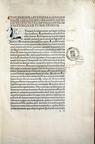
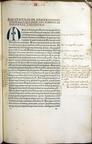
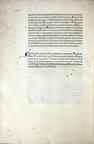
Left to right: first page,
sample page (with handwriting), colophon page.
Consider these questions as you read in order to gauge your understanding of the text. Hint: You may want to print this page and mark the key words and phrases relevant to these questions.
644b23. Of substances constituted by nature some are ungenerated, imperishable, and eternal [i.e., the heavenly bodies], while others are subject to generation and decay. The former are excellent and divine, but less accessible to knowledge. The evidence that might throw light on them, and on the problems which we long to solve respecting them, is furnished but scantily by sensation; whereas respecting perishable plants and animals we have abundant information, living as we do in their midst, and ample data may be collected concerning all their various kinds, if only we are willing to take sufficient pains. Both departments, however, have their special charm. The scanty conceptions to which we can attain of celestial things give us, from their excellence, more pleasure than all our knowledge of the world in which we live; just as a half glimpse of persons that we love is more delightful than an accurate view of other things, whatever their number and dimensions. On the other hand, in certitude and in completeness our knowledge of terrestrial things has the advantage. Moreover, their greater nearness and affinity to us balances somewhat the loftier interest of the heavenly things that are the objects of the higher philosophy.
645a5. Having already treated of the celestial world, as far as our conjectures could reach, we proceed to treat of animals, without omitting, to the best of our ability, any member of the kingdom, however ignoble. For if some have no graces to charm the sense, yet nature, which fashioned them, gives amazing pleasure in their study to all who can trace links of causation, and are inclined to philosophy. Indeed, it would be strange if mimic representations of them were attractive, because they disclose the mimetic skill of the painter or sculptor, and the original realities themselves were not more interesting, to all at any rate who have eyes to discern the causes. We therefore must not recoil with childish aversion from the examination of the humbler animals. Every realm of nature is marvellous: and as Heraclitus, when the strangers who came to visit him found him warming himself at the furnace in the kitchen and hesitated to go in, is reported to have bidden them not to be afraid to enter, as even in that kitchen divinities were present, so we should venture on the study of every kind of animal without distaste; for each and all will reveal to us something natural and something beautiful.
645a26. If any person thinks the examination of the rest of the animal kingdom an unworthy task, he must hold in like disesteem the study of man. For no one can look at the elements of the human frame—blood, flesh, bones, vessels, and the like—without much repugnance. Moreover, when any one of the parts or structures, be it which it may, is under discussion, it must not be supposed that it is its material composition to which attention is being directed or which is the object of the discussion, but rather the total form. Similarly, the true object of architecture is not bricks, mortar, or timber, but the house; and so the principal object of natural philosophy is not the material elements, but their composition, and the totality of the substance, independently of which they have no existence.
Do you have a great quote for this page? Let me know! (If used, a new quote is worth 1 point extra credit)

|
HSCI 3013. History
of Science to 17th century |
spellcheck.net | wordcounter.net
Many thanks to the pedagogical model developed in Mythology and Folklore and other online courses by Laura Gibbs, which have been an inspiration for this course.
|
|
This course is currently undergoing major reconstruction to bring it into alignment with the new version of the course at Janux |
|||


