|
 |
|
Stonehenge Introduction
| Stonehenge index | Next page |
You are standing within the circle of Stonehenge, peering out between two vertical stones of a trilithon (= three large stones with one crossways on top of the other two) at the distant heel stone.
Imagine asking yourself:
Why did someone do this? |
Stonehenge has been hailed as an astronomical temple built by Merlin or Celtic druids. As with the roughly contemporaneous Egyptian pyramids, all manner of unsubstantiated claims have been advanced regarding its purposes and astronomical functions. Unfortunately for such speculators, however, there is no doubt that Stonehenge predates the druids.
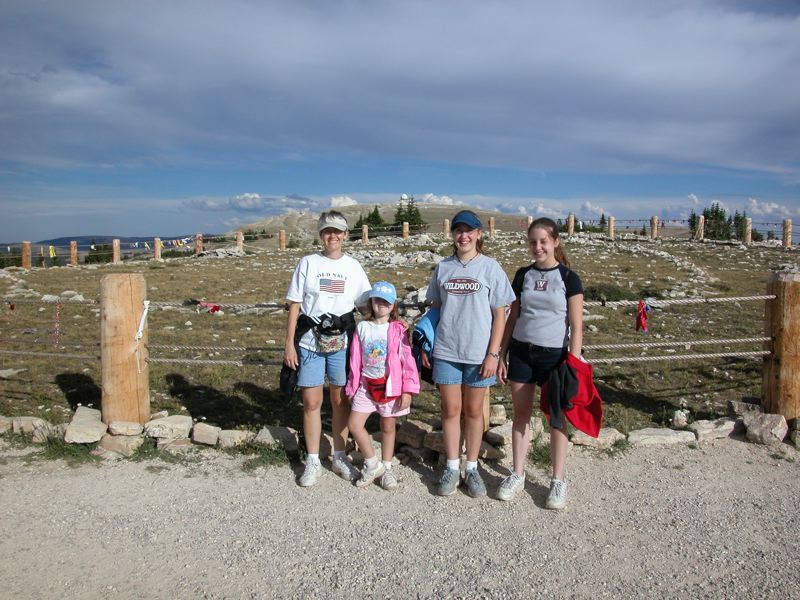
Other megalithic structures are found worldwide: there are nearly a thousand other stone rings in Britain and continental Europe, or here in America one can visit Woodhenge in Cahokia, Illinois, or the Medicine Wheel in northern Wyoming, to name but two of many circles; all of these were obviously accomplished without the help of Merlin.
Why did early Americans do this? |
Such structures demonstrate the capability of various pre-literate cultures to recognize many of the basic celestial phenomena we have forgotten today, some of which we will become acquainted with during this course. And these structures demonstrate that human beings over the last few centuries have found the interpretation and reconstruction of the history of science as interesting as it is challenging.
(Vocabulary note: "Phenomena" = "appearances"; "phenomenon" = "appearance." Science is the attempt to explain natural phenomena. Since "causes" are a common form of explanation, causes and phenomena are often contrasted.)
Can we use Stonehenge as an example of the study of history? Turn to the next page to consider how...
| Stonehenge index | Next
page |
"Here oft, when Evening sheds her twilight ray,
And gilds with fainter beam departing day,
With breathless gaze, and cheek with terror pale,
The lingering shepherd startles at the tale,
How, at deep midnight, by the moon’s chill glance,
Unearthly forms prolong the viewless dance;
While on each whisp’ring breeze that murmurs by,
His busied fancy hears the hollow sigh."
-- from “Stonehenge,” by Thomas Stokes Salmon, 1823

|
HSCI 3013. History
of Science to 17th century |
spellcheck.net | wordcounter.net
Many thanks to the pedagogical model developed in Mythology and Folklore and other online courses by Laura Gibbs, which have been an inspiration for this course.
|
|
This course is currently undergoing major reconstruction to bring it into alignment with the new version of the course at Janux |
|||