


 |
 |
|
5. Without evidence, history is speculation
| Previous page | Stonehenge index |
Generalizations about the past are common, and uncommonly unreliable because of this tendency for rational reconstruction. When you look through the wrong end of a telescope, close-up things seem distant but very clear. So oftentimes when we think we are looking at the past we are really getting a clear vision of close-up things in the historian's present. The "historical perspective" we gain with increasing distance from the events often represents merely increased confidence in generalizations which can no longer be disproven, and which we would never have dared to make had more contemporary evidence survived to reach us. Sometimes our "degree of confidence" in a generalization is too often a function of the lack of evidence for the entire matter, a problem which is rarely overcome to everyone's satisfaction. Unfortunately, this applies to 95% of secondary works, despite their seriousness. (Someone once said: "A monkey can wear an expression of seriousness that would do credit to any scholar, but the monkey is serious because it itches...")
So how can you assess the reliability of historical work? How can you distinguish between valid historical claims and mere historical fiction, that is, unwarranted speculation about the past?
One answer is through mathematics. In the case of megaliths like Stonehenge, Crowe describes how statistical methods analyzing hundreds of stone circles, not just Stonehenge, can help us to distinguish between the alleged alignments we can find, and the actual alignments that were originally intended by the builders. Single pieces of evidence, considered in isolation, are susceptible to distortion by idiosyncratic interpretations. Read now Crowe's summary of the research of Alexander Thom (pp. 215-218), and consider why it is that Thom's statistical work is foundational for modern study of Stonehenge.
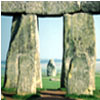
Another answer is through the study of artifacts that have survived into the present, whether buildings, sculptures, instruments, books, or other written records. For example, archaeology provides essential evidence for reconstructing the original construction and uses of Stonehenge:
To control speculation it is usually necessary to confine ourselves to the
interpretation of presently-existing artifacts or documents. The purpose of
historical research is to explain the existence of these (their later history
is important too). Valid historical inquiry does not attempt to answer
questions requiring speculation for which there is no extant evidence.
For example, the question "Did the people who used Stonehenge believe
in life on other worlds?" is not a historical question, because there
simply is no evidence one way or the other, and one cannot discuss it with any
historical warrant. Much the same might be said for the occasional view: Was
Stonehenge built with the assistance of intelligent visitors from outer space?
Questions like these fall beyond presently existing evidence, and are fruitless.
Because of the absence of available written evidence pertaining to Stonehenge,
there is a clear limit to what historians can say about it. This is why it is
often said that "history begins at Sumer," where the earliest documents
written in cuneiform were discovered (as we'll see next week). Historians accept
these limitations: we do not attempt to answer all possible questions about
the past. Much meaningful knowledge is beyond the reach of the historian using
historical methods. This may be sad, but it's even sadder not to recognize that
it is so.
| Back to Stonehenge index | Back to Context assignment page |
"Pile
of Stone-henge! so proud to hint yet keep
Thy secrets, thou that lov'st to stand and hear
The Plain resounding to the whirlwind's sweep,
Inmate of lonesome Nature's endless year;
Even if thou saw'st the giant wicker rear
For sacrifice its throngs of living men,
Before thy face did ever wretch appear, Who in his heart had groaned with deadlier
pain
Than he who, tempest-driven, thy shelter now would gain."
--William Wordsworth, "Guilt and Sorrow; or Incidents upon Salisbury Plain"

|
HSCI 3013. History
of Science to 17th century |
spellcheck.net | wordcounter.net
Many thanks to the pedagogical model developed in Mythology and Folklore and other online courses by Laura Gibbs, which have been an inspiration for this course.
|
|
This course is currently undergoing major reconstruction to bring it into alignment with the new version of the course at Janux |
|||


