Quartz

| Mineral List | Rock List | Guidelines for Rock Collections |

Other names:
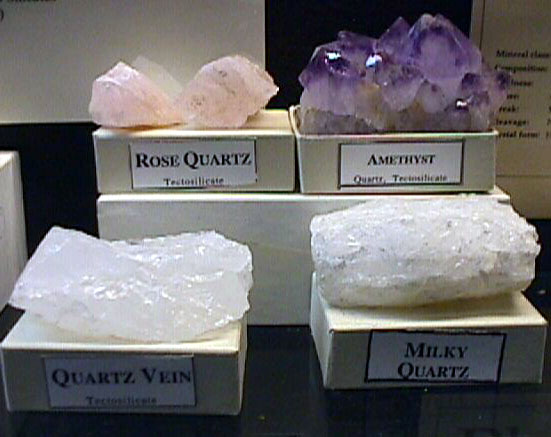
  • Quartz occurs as a clear quartz crystal form (often found in geodes), as a sparkling white vein quartz, as a whitish milky quartz, a pink rose quartz, a dark smoky quartz, and as a purple amethyst.
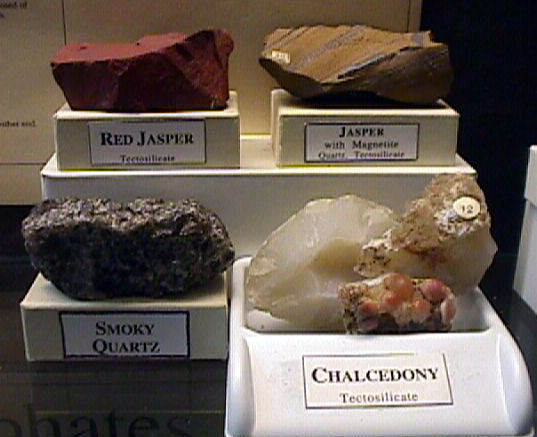
  • Chalcedony occurs in globular masses with a waxy luster, and is grey, cream, or light brown.
  • Agate is a many-colored, banded form of chalcedony.
  • Jasper is a mottled yellow, red, brown, or green variety of quartz.
  • Chert or flint is an opaque, dark black, grey or brown, compact variety, often used for cutting instruments because of its sharp edges when fractured. Chert (or flint) occurs as nodules which form by chemical replacement in limestone formations; a famous example is the Chalk formation of England (exposed in the famous white cliffs of Dover). Chert (or flint) also forms layers interbedded with limestone which settled out of seas containing diatoms and other plankton organisms whose skeletons were composed of silica, as in the Flint Hills of southeastern Kansas.
  • Hydrated silica is known as opal.
Mineral class:Tectosilicate
Composition:Silica (silicon dioxide), SiO2
Hardness:7
Luster:Glassy to greasy
Streak:White
Cleavage:None
Crystal form:Hexagonal. Six-sided prisms with pyramid caps at either end.
Environment:Many different environments, metamorphic constituent of hypothermal, mesothermal and epithermal veins. Quartz crystals are commonly found in geodes.
Comments:Quartz is the most common mineral on the Earth's surface.

Quartz is easily distinguished from calcite because it scratches glass, is usually not scratched by a knife, and does not react with HCl.

Most sands and sandstones are composed of worn quartz particles. Sandstone metamorphoses to form quartzite. [quartzes.jpg] [quartzJasperChalcedony.jpg] [quartzWindSculpturing.jpg]