
| Rock class: | Clastic Sedimentary Rock |
| Color: | Varies considerably |
| Grain: | Pebble diameters larger than 4 mm (0.16 in); matrix grains larger than 2 mm (0.08 in) |
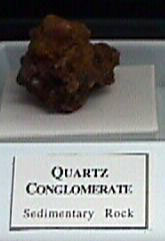
| Environment: | Conglomerates form when gravel consolidates in shallow and turbulent water, such as occur with torrential fluvial deposits or marine transgressions. |
| Uses: | Building stone. |
| Comments: | Conglomerates are among the most fascinating of rocks because every conglomerate poses a mystery, the solution of which will be a complex story. Consider the inferences drawn in one example as described by John McPhee, {\i Annals of the Former World,} p. 217: ÒIt has been AnitaÕs style as a geologist to begin with an outcrop and address herself to history from there--to begin with what she can touch, and then to reason her way back through time as far as she can go. A river conglomerate, as tangible rock, unarguably presents the river. The river speaks of higher ground. The volume of sediment that the river has carried can imply a range of mountains. To find Precambrian jaspers in the beds of younger rivers means that the Precambrian, the so-called basement rock, was lifted to form the mountains. These are sensible inferences....Ó
|