
| Rock class: | Extrusive Igneous Rock |
| Composition: | Plagioclase (labradorite-bytownite) and pyroxene, with various other minerals. |
| Color: | Black, Dark grey, Dark red |
| Grain: | Fine |
| Environment: | A vociferous debate about the origin of basalt occupied many geologists around 1800 wherein many followers of the mineralogist Abraham Gottlob Werner (who argued for its aqueous origin) nevertheless adopted the view of its igneous origin (as argued by James Hutton). Basalts are found near volcanos and volcanic islands, and on the ocean floor, particularly at the mid-Atlantic ridge (where new ocean floor is being created). |
| Uses: | Building stone, road material. |
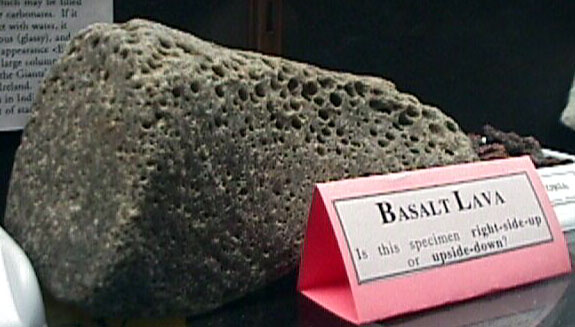
| Comments: | May be massive and compact, or occur with vacuoles (amygdules) which may be filled with zeolites or carbonates. If it cools in contact with water, it becomes vitreous (glassy), and fractured. Its appearance in situ as large columns is famous, as at the Giants' Causeway in Ireland. The Deccan Traps in India comprise a basalt deposit of staggering size.
 |