| Other names: | Heavy spar |
| Mineral class: | Sulfate |
| Composition: | Barium sulfate, BaSO4 |
| Hardness: | 3 - 3.5 |
| Luster: | Vitreous |
| Color: | Colorless, White, Green, Red, Yellow |
| Streak: | White |
| Cleavage: | Perfect cleavage in 2 directions at right angles. Imperfect cleavage in third direction. |
| Specific Gravity: | 4.48 |
| Crystal form: | Orthorhombic |
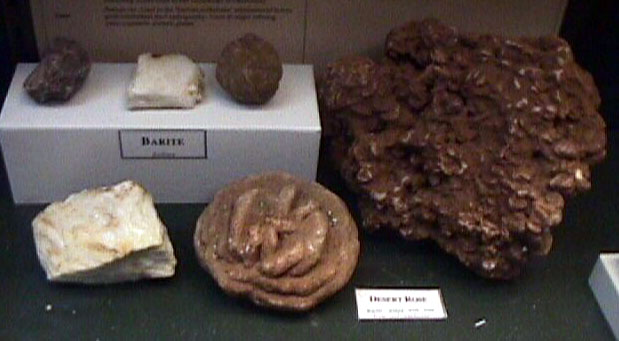
| Environment: | Septarian concretions in sedimentary formations; in petrified wood; veins; cementing material for sedimentary rocks (including desert roses in red sandstones of Oklahoma). |
| Uses: | Barium ore. Used in the "barium milkshake" administered before gastro-intestinal tract radiography. Used in sugar refining, paint pigments, pottery glazes. |
| Comments: | Scratched by knife but not fingernail. Barite is harder than gypsum, does not react with HCl like calcite. Flame Test: yellow-green (a similar appearing mineral, Celestite, turns red). Some varieties are fluorescent in UV light. Insoluble in acids. Enormous crystals up to 1 meter diameter have been found in European hydrothermal veins.
The Oklahoma "Rose Rock" or "desert rose" is a distinctive variety of Barite, which obtains its reddish color from the iron sandstones in which it occurs. They are also found in the Sahara. Black varieties of barite derive their pigmentation from bituminous matter.
|